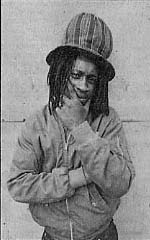
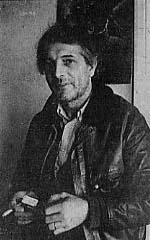
CHRIS SALEWICZ MEETS TWO OF THE PEOPLE BEHIND THE CONTROVERSIAL 'BABYLON' - DIRECTOR FRANCO ROSSO (RIGHT) AND ASWAD'S BRINSLEY DAN
|
CHRIS SALEWICZ MEETS TWO OF THE PEOPLE BEHIND THE CONTROVERSIAL 'BABYLON' - DIRECTOR FRANCO ROSSO (RIGHT) AND ASWAD'S BRINSLEY DAN |
|
With a visual rhythm akin to the sound system competition sequence that opens the film, Franco Rosso’s Babylon will be seen in years to come as crucial to any understanding of the social situation in Britain at the beginning of the ‘80s.
Set predominantly amongst the South London black community, the film is an episodic account of the external and internal pressures that draw car mechanic and part-time toaster Blue (Aswad guitarist Brinsley Dan) into an ostensibly downward spiral that culminates in his impulsive stabbing of a racially abusive white. In the final scene, again at a sound system battle, he recovers his sense of self through a toasting performance the power of which is inter-related with the deeper understanding of Rastafarianism and black identity that he has gained during the course of the film.
"Babylon is as accurate as you can go in a film," says Brinsley.
"People are going to complain that it shows certain sides of life in Britain that can seem very negative. But, in fact, the film just provides, and tries to explain, certain details. It leads up to an incident where action becomes physical and violence is directed towards another person. Yet all it’s doing really is showing the pressures that lead people to do certain things within that system."
Also seated in the front room of Brinsley’s upstairs flat off of Poitobello Road is the director of Babylon, Franco Rosso. He is concerned that the implied reasons for the problems portrayed in his film may not be clear to all. Franco feels, though, that they couldn’t have been more explicit without altering its essence: Some people certainly wanted to show more than just the implications - they were worried that the points were not made sufficiently strongly.
"But in that case you’d enter a very difficult area. To do what they want you’d have to make something very close to direct propaganda. Which would leave a white audience totally and utterly outside of the film, and unable to come into it."
"To me," adds Brinsley, "the film is trying to show that we’ve got to work together, because we can’t achieve anything on our own.
"Okay, Blue goes and stabs someone - his back is against the wall and he strikes out. But, in the end, it’s down to the support of everyone - when everyone stands in the hall at the end it’s about working together. Whatever happens there has been done together. It’s the only way anything can happen."
 It
is five years since Franco Rosso and Martin Steliman wrote together the original
draft of Babylon for BBC-TV’s Play For Today series. It was
never made, and so they decided to adapt the script as a feature film.
It
is five years since Franco Rosso and Martin Steliman wrote together the original
draft of Babylon for BBC-TV’s Play For Today series. It was
never made, and so they decided to adapt the script as a feature film.
It wasn’t until the end of last year that the National Film Finance Corporation (NFFC) came up with the necessary money for the six weeks of shooting and subsequent costs that Babylon required. Originally contacted in an attempt to sell them the soundtrack LP, Chrysalis came up with £30,000 on the strength of the script rather than on that of the music - the company didn’t commit itself to the album until some months later.
The final costs of Babylon have been remarkably cheap: as opposed to the two million spent on Breaking Glass, the Rosso film totted up £372,000 - roughly the same as any of the recent Dennis Potter TV films. Rosso, whose laconic liveliness is a constant reminder of his origins, was born in 1942 in Italy. His parents emigrated to England at the end of World War II. Educated at Camberwell Art College and the Royal College of Art (at which he was a contemporary of Ian Dury who will star in his next - non-musical! - film), he worked as assistant editor to Ken Loach on Kes, and has directed promo films for John Lennon and Dury in addition to having made a significant number of (mostly black-orientated) documentaries.
Dread Beat And Blood, his Omnibus documentary on Linton Kwesi Johnson, is the most widely known of these. He is amused rather than irritated by its having been re-scheduled by the BBC until after the last General Election. Despite the unanimous critical praise heaped so far upon Babylon he regards its surprisingly harsh ‘X’ certificate as the first of many crosses the film will have to bear.
Franco is certain his Italian background granted him a different perspective on England. "A lot of the film," he affirms in his South-East London accent, "is close to auto-biographical. Definitely! Obviously it’s been moved on a few years. But instead of things getting better, they’ve got worse. There’s a very natural sympathy, because a lot of my experiences are very similar, even though they may not be exactly the same - visually I’m not that different from English people, for example.
"Oddly enough, it was only when I was looking at the film the other night that I realised that similarity. I was amazed. So I suppose that must have been one of the reasons why sub-consciously I wanted to do the film."
Though he has been a member of Aswad since the group came together in 1975, the dynamically lethargic Brinsley Dan started off his career on the boards as an actor. British-born, of Guyanese parents, Brinsley had roles in many British children’s TV plays, as well as John Boorman’s Leo The Lost, before discovering the, for him, greater joys of music.
Even aside from the undoubted publicity spin-off that Aswad will receive from Babylon, the group’s star is certainly in the ascendant. For some two years now the five-piece outfit has been regarded as the finely perfected spearhead of British reggae bands. It’s ironic, indeed, that ‘Hulet’, the most recent Aswad LP, has been licensed by Grove Music to Island, who in 1977 dropped the group after one LP.
"Now," shrugs Brinsley, "that people have got the knowledge that something’s happening, they’ll just go and take a listen.
"The problem has been that up till now we just haven’t had the facilities to do what we wanted. But we were given a chance to do ‘Warrior Charge’ as a Disco-45 for Chrysalis, which is in the film and which has caused the buzz again. But if a company had just put something into us they would have got that long ago. ‘Warrior Charge’ is just a small part of what’s really there."
"It’s very funny," adds Franco. "In Sounds there was a review of the film and they completely hated it - which is fair enough. But the guy who reviewed it is so fuckin’ hip that one of the points he made was that no decent sound system would ever play ‘Warrior Charge’.
"What he didn’t know, of course, was that Shaka was playing all the dubs of ‘Warrior Charge’ and couldn’t get enough of them. It was like snobbism in reverse. Very odd."
Indeed, in Babylon, the character of Ronnie, a white would-be Rasta, suggests much of the identity confusion prevalent amongst obsessive white reggae freaks.
Says Brinsley: "It’s that thing of reversing roles. Like a black youth trying to become a white youth, or vice-versa. You can never do it. You have to be who you are. And you have to realise you can still get on together."
 Another
central theme of Babylon is the iniquity of the ‘Sus’ law.
"A black kid," points out Franco, "is going to be used to having
a certain kind of treatment. If it’s late at night and a car with a load
of white guys in it follows him he’ll either panic and run, or stop and
hope. If he runs, the cops in the car will have triggered off within them an
automatic response: they assume they’re seeing guilt."
Another
central theme of Babylon is the iniquity of the ‘Sus’ law.
"A black kid," points out Franco, "is going to be used to having
a certain kind of treatment. If it’s late at night and a car with a load
of white guys in it follows him he’ll either panic and run, or stop and
hope. If he runs, the cops in the car will have triggered off within them an
automatic response: they assume they’re seeing guilt."
Working as advisor on Babylon was the former London policeman who’d had the same task on the "controversial" Tony Garnett TV series, Law And Order. "He told us," explains Franco, "that that sort of situation gets really exciting for a copper: His adrenalin really gets going. In fact, if that happens it’s almost better to take what’s coming to you. Because once you run, those guys really get into it.
"It was the same with the final scene. He told us that they all carry things like sledgehammers - in the boots of their cars. He used to, he said, and all his detective mates. Which is why we let them sledgehammer the door down. If those two cops who initially approach the downstairs door couldn’t have got entry they’d have gone mad. The cops would have just kept coming, -and they would’ve massacred the people in the hall."
The final scene is based on an actual incident. Some six years ago the Carib Club (aka Burton’s) in Willesden was raided. Franco: "Dennis Bovell was inside for six months just waiting as a suspect. He’d been playing the sound system that night, and they claimed he’d been egging the people on.
"A couple of cops ran in and started trying to arrest people and when they got turfed out a fight started. More police came and lined the stairs and as people were leaving they were physically attacked."
Hearing the sound of children’s voices in the street, Brinsley opens his window and peers out. Three black children, of primary school age, are trying to attract his attention: they want to know when Babylon will open and whether they may go and see it. Reluctantly, Brinsley has to point out to them it is an ‘X’. "See," he says, closing the window, "they’re exactly the age-group who should see the film - to make sure they don’t end up stabbing people when the pressure gets too much.
"But," he shrugs sadly, "the system won’t allow them to watch it. I wonder why?"
See also: Feature on Babylon from Espresso Magazine (in Italian)
