LONDON ACID CITY: When the Two 8’s Clash
“I don’t think many readers have really understood what I set out to do with The Assault on Culture. My principle concern was actually with the construction of histories, the process of historification, the fact that no matter how much attention is paid to detail; the construction of a history is always a process of radical simplification which grossly distorts the subject under discussion.”
Stewart Home interviewed by Fabio Zucchella in Pulp Libri #3, Rome September/October 1996.
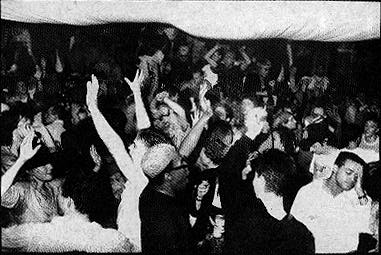
If you read most of the books about acid house you are presented with a tale of energy, excitement, hedonism and positivity – a revolution taking place in our lifetimes which may yet rival the 1960s. Bleeps and pills heralded a new era in culture, with the nation’s youth rising as one to put their hands in the air – only challenged by the tabloids and cops.
Well I’m not about to dispute that, but it seems that the arrival of acid house wasn’t greeted with universal acclaim in all quarters.
Exhibit A
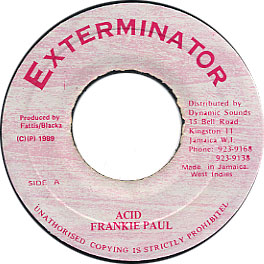 Frankie Paul – Acid (Exterminator 7”, 1989)
On first hearing, this is another wonderful example of “trend jumping” in reggae, with whatever is in the news turning up on records the next weekend:
“Well I took a trip down to London town
To hear the talk wi a go round
At the new stylee – 89 click
Click of the century
Dem talk ‘bout aciiid
Dem a dance aciiid”
Frankie Paul leaping on the bandwagon and describing acid as a new dance, alongside yard staples such as “jump and spread out” and Water Pumping etc. The area of dance crazes following hit tunes in JA culture is really under-exposed, although it had an overground resurgence with Sean Paul’s Like Glue recently – the video and fold-out sleeve for the 7” both giving step by step instructions for all you dancehall queens out there.
However all is not what it seems – later choruses in the track proclaim:
“Aciiid – don’t you dance the aciiid”.
So – what up, Mr Paul?
Exhibit B
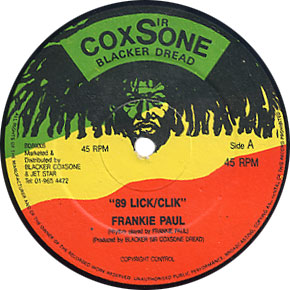 Frankie Paul – 89 Lick/Click (Blacker Dread 12”, 1989)
89 Lick is essentially the same riddim – with added anglicised lyrics (Blacker Dread being based in south London, whilst (E)xterminator runs out of Kingston). So the dances now include “breakdance” in addition to Water Pumping and a reference to watching Channel 4 gets thrown in as well! Plus:
“I know a girl, she’s from Brixton town
Every time I see her she always wear a frown
…She a dance aciiid”“Jamaicans talk about jump and spread out
English talk ‘bout aciiid”“Dennis Brown he don’t like no acid
Frankie Paul he will never try no acid”
It’s kind of light hearted, with an anti-drugs message lurking somewhere in the background, I guess. The sort of thing you might expect someone to come out with if they had just just blown into town for a few days and experienced the explosion of “the 2nd summer of love”™, perhaps.
Exhibit C
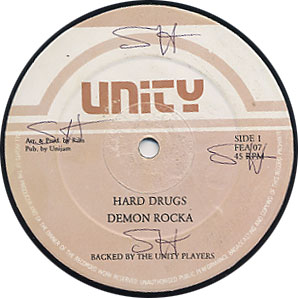 Demon Rocker – Hard Drugs (Unity 12″, 1989?)
Since the excellent Honest Jon’s retrospective Watch How the People Dancing we are all obliged to refer to “the collectible Unity Sounds label”. At least you get that impression from ebay.
Unity, for those who haven’t got the compilation, is one of the key points in the evolution of the London (and hence UK) reggae soundsystem scene. It’s all dealt with superbly in the sleevenotes to the comp, so I shan’t bother getting too deep into the history here. For our purposes it is worth remembering that Unity were one of the first (if not the first) crews to start producing their own digital riddims in the wake of “sleng teng”. Indeed, because of their connections with Jammys, they were also one of the first UK sounds to play sleng teng.
Here you have a sound which has been playing digital dance music since 1985, and releasing its own twelves for a slightly shorter period. This gives them a good 3 years jump on acid house. So obviously the arrival of the loved-up 808 massive with the smiley bandanas is welcomed with open arms, no? Well…
“Now dis one dedicated to all the yout dem wi a take dis acid ting
We no love it – we fight against it, it bad bad bad”[chorus] “some a holla fi de drug and when they get it can’t manage it”
“Now de acid business come a kill de yout dem
me a warn all de nice young people dem”
A lot of the Unity tracks which didn’t make it onto the compilation have a very strong and occasionally discomforting moral tone to them, so it’s not that much of a surprise to hear that Demon Rocker wants the youth to be taking sensi and not LSD, or that ecstasy is “a mind bending drug”.
What’s compelling about this tune is the way that Demon Rocker (aka Demon Rocka and Deman Rocker) explicitly adopts the ancient role of the folkloric storyteller. The lyrics are a complete linear narrative and there is a crystal clear moral to the story. It revolves around Demon’s experiences of his mate Mark who gets a new job, becomes a yuppie and invites him to a party up in Finchley (of all places!). Great party: “white and black dem a mingle and have a good time”.
But wouldn’t you know it:
“Next thing a man come in with a pouch pon him side
Everyone start rush him from back and side
Me feel him must be someone everyone like
But him a sell ecstasy – 25 pounds a time”“Them a start play some music me never hear in me life
and put on some big bright flashing lights
People start shout ‘acid!’ at the top a dem voice
When me see certain thing me eyes open up wide”
And indeed the rest of the tune descends into drug-fuelled debauchery (admittedly with a probably conscious sense of the ridiculous): it’s a catalogue of public sexual acts, people bringing their bicycles inside and riding them around, fighting, women showing their arses, and men dancing with one another. Now for some people, that might sound like quite banging night out (or indeed an ordinary Wednesday night in), but that is not The Way of the Righteous:
“So me tell all de yout no take LSD
and keep your backside out a acid party”
What is most interesting for me is not the initial impact of acid house on a vibrant, electronic, ganja-fuelled dance music scene, but the two trajectories of these attitudes and activity in the following years.
Firstly, the UK roots scene, which has (let’s face it) rarely been a launchpad for futurism or innovation, was pretty slow to catch on to the babylonian un-ital digital riddim.

The track which gets credited for shaking everything up (in all senses!) is Warrior Stance by Bedford’s Dread and Fred. According to the Rough Guide, this actually came out in 1988 as a 12” on Jah Shaka’s label, which is impressive if you think about it in terms of acid house, but a bit of a lag in reggae terms when you consider sleng teng and its various precursors. (Though I’m sure Shaka caned it on dubplate for ages before its release.)
Apparently there were serious mixed feelings amongst the cognoscenti about the arrival of Warrior Stance and the tracks which followed it. In some ways the purists were right to be nervous, because a load of producers such as Iration Steppas saw to it that UK Roots would never be the same again.
And it wasn’t just the music, either – people felt that the message was subtly shifting away from rastafari – into a void:
“I’m kind of disheartened with the roots now, because when you’re talking about roots, you’re talking about rasta music. If you’re talking about dub that’s fine enough, but to me dub is just the rhythm, but roots is the message and without a message there is no vision. […] now I find the roots scene in England is turning more to the dub and away from the roots. You’ve got a lot of sound systems claiming to be roots sounds, and they’re not defending what they’re saying. […] It’s also become a freak kind of thing, when I see people who are the overspills from the acid dances and gothic people, and I know none of them are in it for the message, none of them have any love for my faith. They’re in it for the dub, so it’s now become another form of rave – you go to an acid dance and hear this thumping bass, well let’s go to Jah Shaka now and hear another kind of thumping bass, you know?”
Danny Red, interviewed in Boomshakalacka #11, October 1992.
This criticism exists to this day, with the University of Dub dances at the Brixton rec particularly coming in for flak because of its audiences’ alleged ecstasy/coke use, whiteness, and general unrighteousness. Obviously this ignores the role that these dances play in bringing a message to people who simply haven’t heard it yet. No doubt there are countless ex-ravers (and possibly even some ex-goths!) who followed Shaka’s thumping bass into a whole new world of reggae music.
On the other hand, we have to consider the (massively under exposed) subsequent trajectory of the Unity Sounds crew and Demon Rocker himself:
“Demon Rocker and Flinty, they went off to be the Ragga Twins, Speccy the Navigator went into the rave scene, travelling all over the world, he’s still doing it now [I have good grounds to believe he is the excellent MC Navigator these days – JE]. Peter Bouncer worked with Rebel MC. They all worked for one person at one stage, Shut Up and Dance I think they called themselves. I thought these guys made it their duty to come to our dances, taking whosoever was on the sound and going off to record them on something else”
Robert Fearon aka Ribs, Unity Sound, interviewed by Honest Jon’s for the sleevenotes to Watch How The People Dancing (Honest Jons HJRCD3 2002)
In some ways, people had to wait for acid house to run its course for all the links to be made. ‘Ardcore allowed the dancehall crews a way in to rave, and the ravers a way back, into dub, reggae and dancehall.
There’s scope for much more on all this – the dialectical relationship between hedonism and righteousness in the London dancehall scene, the role of technology and drugs, the furious importing and exporting of beats and styles. Somewhere there is a book to be written on the role of Saxon, Jah Tubbys, Heatwave, Jah Shaka, Unity and countless others in the ‘ardkore continuum.
Prices of old records being what they are, it’s unlikely that I will be the one to put anything cohesive together, but I hope you’ve enjoyed reading this as much as I’ve enjoyed cramming another piece into the jigsaw. There is always another story to tell, which is why I am wary of historification as a process. Fortunately, in the blogosphere and elsewhere, there is always someone willing to tell another story and I await the next chapter with much interest…
Thanks to Danny and Tim P.
Since publication, this article has been kindly referred to by:
Anthony Iles and Eve Lear in their piece Media, Secession and Recession (cesura-acceso)
Ornette in his piece on X Amount Crew’s – “can’t do it alone” [unreleased, 1993] (blogtotheoldskool)
k-punk: REASONS TO BE THANKFUL TO UKIP
Whilst I take k-punk’s point, I refuse to be grateful to those fuckers.
Things look pretty bleak – the fact that we are having to scrabble around being glad that the far right vote has been split, rather than decimated, is cause for thought.
Of the results that are published so far it looks like 1,322,162 people put their cross against UKIP in the euro elections and 387,905 others did the same for the BNP.
So, not even including the plonkers of “England First” and various other “hobbyist” projects for stiff-right-armers, that means nearly 3 million people in this country are happy to vote for the far right.
Furthermore, it seems to me that the votes are being split along class lines, with middle class middle englanders voting for UKIP and traditional white working class areas voting BNP.

This is a disaster made even worse by the absolutely bizarre machinations of the weird alliance of the SWP, Geroge Galloway and the political islamists in Respect. Who got naff all seats anywhere, despite gorgeous George (the Swiss Tony of the left) boasting about “a million pounds, a million votes” before the event. However, the usual gesture politics, hectoring people and banging on about Iraq at the expense of anything else (including listening to people) has unsurprisingly not paid off.
The ONLY real good news last Friday was in the local elections, with the Greens and the Independent Working Class Association providing a serious challenge to New Labour in Oxford. From what I have read, both parties have managed to do this without the hype or hysteria of either UKIP, or Respect, but by working with people on a local level and actually trying to engage with their concerns in a creative and constructive way. From small seeds…
remember to allow for your clothes
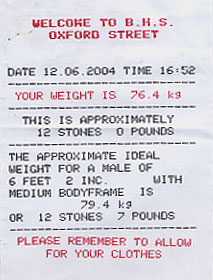
It is your character/Deep in your nature
Take one example/Sample and hold
Romance and replace/The lack in yourself
It is your nature/It is your nature
We see you climbing/Improving the effort
Wearing my suit/It is your character
There is a limit/Over your shoulder
Everyone loves you/Until they know you
It’s not that I don’t like my body, it’s just that we have an understanding – an agreement. A recognition of what is likely to work and what is not.
For example, I have absolutely shocking co-ordination – classic “pick me last!” pratfall Mr Bean bizness. So I will not be volunteering for your football team, if that’s ok.
I will also categorically refuse to go shopping for clothes under any circumstances less extreme than threats of violence against my person by those close to me.
Part of this is because I’m just not interested – my parents used to give me money to go and buy clothes and I’d spend it all on records and try desperately to find something to fit me in a charity shop afterwards.
Part of it is that I’m just the wrong shape for clothes on your planet: 6 foot 2, massive shoulders, skinny as you like. Plus not really having a disposable income any more doesn’t exactly help.
Anyway, I had to get a new suit, cos my existing one (and I certainly don’t need more than one suit…) is falling to bits and has an added bonus feature of bulging at the flies to make me look like a deranged sex pervert. And also because of an impending wedding, and the AGM at the charity where I work. Conformist, moi?
So there we were, mob-handed in the West End on a saturday afternoon (I need a gang with me or I will spend all the money on records and/or purchase a fashion disaster of almost apocalyptic proportions).
It’s really alienating down there, isn’t it? Not just the crowds, but the fact that there are so many people who seem at ease with themselves. Possibly because they are the sort of people who not only know instinctively what looks good, but can also walk into a shop and find stuff that fits them straight away. I swear the first shop we went into just didn’t stock trousers my size.
“They” are all glam and trendy and smiling (these weirdos looked like they were enjoying themselves FFS!). I am the tall, gangly man, looking like a shoplifter. I also have crackhead-red eyes and am constantly sneezing because of my hayfever. Every time I try on a suit I keep checking the crotch to see if the fly is going to pull the same deranged sex pervert trick as the last one.
So people steer well clear of me, which is actually a bit of a result considering how crowded everwhere is. Partner, daughter and my sister display the patience of saints as I try on a series of suits which are all not quite OK. Inevitably my sister bumps into some of her crushingly trendy gay mates and I feel for a moment like I am about to be transported into some hellish makeover programme scenario. Fortunately for everyone they saw the awesome task in front of them and made their excuses.
We got the suit (Top Shop, nice one). But I’m not doing that again.
mulling “the lull”
The problem with the UK underground press in the 60s was that it was concentrated in a few offices – you had Oz, International Times and Frendz. OK, so there were a load of smaller, local affairs as well (Genesis P-Orridge did a Hull based magazine called W.O.R.M. for example), but the bulk of the readership relied on getting hold of 3 magazines for their counter culture reading fix.
The problem with this was twofold – firstly Oz kept on getting busted, which meant that the availability of subversive information was immediately cut by a third while they paid legal fees etc.
The 2nd problem was that people concentrated on the major indies as consumers – it just wasn’t possible to produce something like Oz (with its colour layouts big list of contributors, advertising, distribution) from your back bedroom. This arguably led to a passive acceptance of what alternative media should look like and contain.
After punk, fanzine culture went into overdrive and the “big 3” were replaced by thousands of small circulation efforts, of varying quality. Now obviously some of these were completely derivative (copying Sniffing Glue, or later adopting the identikit anarcho-punk concerns) but the scope was there for people to produce their own brilliantly idiosyncratic ranty zines – and many did.
Some zines came and went after one issue, whilst others became regular treats.
I keep banging on about zine/cassette culture, but I do think there are some important lessons to be learnt. The first one is that people shouldn’t panic about their favourite blog disappearing (either temporarily OR permanently). Someone else will come along who is even better – and if they don’t you should get off your fucking arse and Do It Yourself.
The second lesson is that we need new voices. What makes Woebot, K-Punk and Blissblog so good is that they already had a voice, an outlet, a personal mythology before beginning their blogs.
And whilst I love them, you can see other people being inspired by their writing in a way which can sometimes be less than interesting. Reynolds’ form of analysing genre-development looms especially large in the blogosphere, for example.
It’s fine being inspired by things (everyone is, and I make no claims to be immune myself) but the problems set in when everyone is inspired by the same things.
I suppose what I am trying to say is that whilst I enjoy Matt and Simon’s writing immensely, I can also see the advantages of their blogs biting the dust. Move over, Grandad! 😉
I’m not saying that they SHOULD stop, just that it is inevitable that things will change – and that is to be celebrated, not feared.
Let a million flowers bloom…
Shards, Fragments and Totems: » The First Taste of Hope is Fear: Ambient Industrial 1980
The First Taste of Hope is Fear: Ambient Industrial 1980-1987 – Paul Meme raises the bar in the blogging stakes considerably!
various artists – Godspunk vol. 2 (Pumf CD)
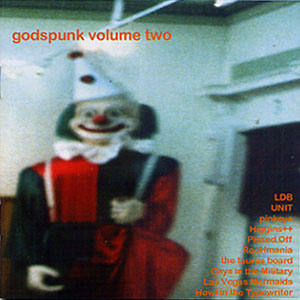
That old post-punk “cassette culture” is still going strong, you just have to look for it. Although regular readers of my comments boxes will note that it has a habit of coming to find me…
Godspunk vol. 1 was one of my favourites of last year, so I was well chuffed to be sent the latest instalment by the man like LDB. It’s a bit of a gargantuan effort this time round, with a whopping 34* tracks by 10 bands. (*Or perhaps, 27 tracks – confusing? Yes!).
Label owners Howl in the Typewriter inhabit low-tech techno & post-punk territory with a nod to Wire, 70s Eno, and a whole truckload of other influences. It’s definitely post-punk in “never went away” modus operandi way, rather than a revival cash-in. (Although hopefully they will do alright now that the stars are correctly aligned again for this sort of stuff!) Some good poppy tunes + cynical lyrics = HIT! “I’m not going to see the mormons again / I don’t think the mormons are my friends.” Innit.
Some more standout tracks from LDB: hip hop stylings which work precisely because he is too white, too old and too grumpy. This set builds on the innovation with the beats etc we saw glimpses of last time – samples of Candi Staton’s You Got The Love, the Pixies, etc. It’s incredible that he does all of this without the aid of a sequencer. Basically I reckon this is just as good as The Streets (but in another direction to them/him), but I am biased. Stadium R ‘n’ B is the HIT! here, Last Days of Rome is the head-nodder for walking those mean streets. Warrior, is the, uh, stoopid rawk number. (I really hope this is a one off!)
“Have you ever been porked? Ever had a man smoke your pole?” Gays In The Military contribute serious homo-swamp-rock topped & tailed with some great campsploitation film samples. Lyrically it’s a voyage into the underworld of yesteryear (?) “the yellow hankie boys/ they don’t like to kiss/ they just want to get down on their knees and drink your piss!” HIT!
Las Vegas Mermaids don’t seem to live in Las Vegas, but I reckon they really are mermaids. Their first track here is a tender, yet upbeat number – a touching daughter’s tribute to her father “you’re just a rich old man with his ball bag hanging out/please put it away/ I’m going to join a commune in France/ and get fisted on stage every night” HIT! Track two is Weevils – deeply twisted sub trip hop “weevils – insects of the night”. Errrrrrr?!
RooHmania’s remix of Howl in the Typewriter (one of their catchiest tracks from volume 1) is a bootleg mashup charting the history of UK pop. It covers Strawberry Fields, Satisfaction, Pretty Vacant, Blue Monday – all killer no filler! Their other track here is a rather fine skittery folk number, like a punkier Beta Band.
UNIT storm in at the last minute to deliver four tracks which average about 2 minutes each. As you would expect they cover quite a lot of ground in that time – a humanist version of All Things Bright and Beautiful and a couple of anti-bigotry rants (one of which is the latest instalment in a long line of autobiographical incidents). Two Weeks in Malaysia is another classic UNIT pop ditty, tailor made for Andy Martin’s delivery: “I know this song isn’t very deep/and maybe it’ll send you fast asleep/but it’s better than pills/or counting sheep” – HIT!
Other tracks veer from experimental field recordings to politicised EBM.
I think it’s safe to say that you won’t find Godspunk vol.2 in the shops, but you can order it for just five quid (inclusive of UK p&p) via the Pumf Records website – while you’re there check out their other releases (including mp3s) by people including the excellent Ceramic Hobs.
The Pop Group jukebox
Dixon who does the essential website dedicated to The Pop Group has now started an excellent mp3 blog dedicated to the band.
This is great news, especially considering the criminal chronic unavailability of Pop Group material in any format.
Crazy Caribs – Dancehall Dub (Ariwa/Mad On Jamaica CD)
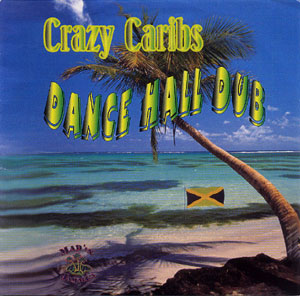
The cover doesn’t do this album any favours. There’s obviously nothing wrong with summery island imagery (that’s where the music originates!), it’s just that this sort of graphic is more usually wrapped around yet another generic compilation featuring a bizarre mixture of Ace of Bass, Marleys Bob and Ziggy and Inner Circle’s “Girl I’m Gonna Make You Sweat” alongside whatever Trojan or whoever is licensing cheap this week.
Everyone knows that to be de rigeur you’ve got to have:
1) A mixing desk and or ganja leaf (dub)
2) A grainy shot of sufferah youth in downtown Kingston (roots – or you can go the whole hog and just ineptly rip off the designs that Intro do for Blood & Fire).
3) De gal dem inna de batty rider (dancehall)
In fact this record does feature the pop hits of the day, but not like you ever heard ’em before.
Crazy Caribs is a Mad Professor project, with the indomitable Mafia & Fluxy versioning contemporary hit riddims and adding their own flavour. The production is as crisp and booming as you would expect. Mad Professor never gets the respect he deserves from the self-loathing UK reggae purists. Needless to say, he rises above the snobbery yet again here – the re-workings are inventive and the whole album is very listenable considering it is entirely instrumental.
This is partly down to the quality of riddims like Coolie Dance, Diwali and Fiesta/”Vitamin S”, but it’s also due to the varieties of studio trickery and instrumentation – some tracks are cavernous bass-driven monsters, some are more floaty and ambient. There are quite a few tunes where the vocal melody is still present as really effective steel pan sound.
Perhaps most surprising is how the imaginative choice of riddims creates a satisfying whole. 50 Cent’s P.I.M.P gets a absolutely wicked re-rub alongside all the bashment, and there is another chapter in the compelling history of the legendary soundsystem dubplate killer Kunte Kinte.
It’s great to hear some proper innovative dub workouts of dancehall riddims after so many mere “backing tracks” – hopefully this will be built on, and become a whole new genre of itself.
Plus, on a sweltering bus journey through London, it isn’t really so bad to be able to look at the cover and forget where you are… for a moment.
world of stelfox
Great Q&A with ace Greensleeves sleeve designer Tony McDermott over at World Of Stelfox.