Radiohead’s OK Computer to get complete reggae treatment.
Follow up to this.
Jamaica Gleaner News – Brent Dowe dies – Monday | January 30, 2006
Sad sad news. “Down Here in Babylon” on Black Art is one of my favourite songs ever – timeless stuff.
There are some people you don’t hear from for a long long time, but maybe stumble upon their name in an old email or address book. And you think to yourself, “I wonder what they’re up to now?” because you know it’ll be something interesting.
This has happened a lot to me recently because I’ve been trying to transfer everything over to a new computer and I’ve found a load of old emails that I meant to do things with, but (because of my usual uselessness) never managed to.
Keir wrote the piece on Punk and Autonomia which got republished on Uncarved. He’s now rejigged it into When Two Sevens Clash: Punk and Autonomia which appears alongside some other texts on the Free Association site. A lot of stuff about summits like the G8 and counter-summits, etc. Personally I have mixed feelings about the whole “summit hopping” phenomenon, but a good case is made on the site.
The first draft of the autonomia piece has apparently been translated (by persons unknown) into Finnish and Russian.

Patrick Maun was the man behind vienese ambient industrialists Immolation by Scum, who I’ve previously mentioned here. Patrick was one of many interesting people flung my way via Peter Rehberg (now of Mego fame).
Referring to comments at the old blog site (which I have yet to upload here), Patrick writes:
“I saw there was some curiosity as to what I was/am up so thought I’d fill you in. I moved back to Minneapolis in ’93, then moved to Amsterdam, then moved back to Minneapolis. I am still recording music but have been working under the name maun since about ’95. While I have been actively recording, music has kind of taken a back seat to the visual art I have been making since the early 90’s. You can check some of it out at http://www.patrickmaun.com. Sound does play a big role in most of my installations and videos.
The music I have been making is pretty similar to what I’ve always done. It’s either quiet and rhythmic, or loud and abrasive. I’ve done a lot of work with various choreographers, so a lot of the music is reflective of that. You can check some of it out here. I also have CD’s of many of my live performances including the show at the Scala and the tour of Czechoslovakia. Let me know if you’d like copies of them. Actually, now that I think of it, I’ll just throw an MP3 of the Scala show online and you can grab it there.
I am sitting on several CD’s that I’d love to release, so if you know anyone interested in distributing them, let me know.
Patrick’s current artistic output “explores the interplay between technology and society, authenticity and power, communications and history”. His site is well worth checking.
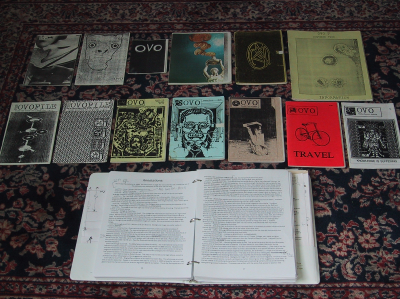
Trevor Blake wrote the critique of Whitehouse collaborator Peter Sotos which I reprinted on Uncarved. I was very pleased to see that this was, for some time, the top google hit when you searched for Sotos. The article was culled from OVO Magazine, which was one of those great lost 90s zines which managed to combine regularity with high quality writing on all sorts of subjects (including many “themed” issues).
Lost… until now…
Greetings
Thank you for publishing my review of PURE from OVO 10 Mayhem. That issue and all the rest (500+ pages) have been scanned, entered into the public domain and posted online. Each issue now has a new introduction, a new issue has been published (theme: sperm) and other issues are in the works (theme for the next issue: AntiChrist) [that issue is now out – JE].
Uncarved looks great, going to spend some time checking it out.
Trevor Blake
The site also includes a nice potted biography which is well worth checking.
Podcast: Play in new window | Download
Subscribe: Apple Podcasts | RSS
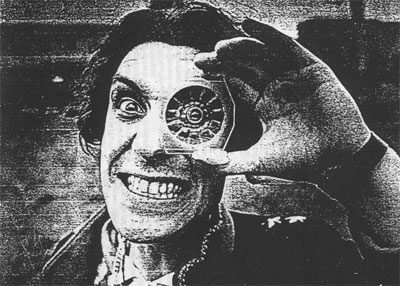
Jack the Tab revisited over at An Idiot’s Guide to Dreaming. Includes a great interview with Richard Norris who went on to be half of The Grid with Dave Ball.
Richard DJ’ed at one of St Albans’ first acid house nights in the autumn of 1988. He’d been involved with the Bam Caruso psychedelia reissue label which was based in the town, and the contact details on the back of the Jack the Tab LP were his Mum’s house, down the road from where I used to look after old ladies instead of getting the shit kicked out of me on the football pitch of a wednesday afternoon.
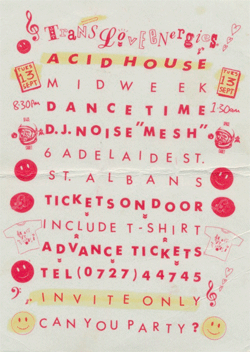
I managed to persuade some of my goth mates to check the club out. It was a mad night – the first time we’d ventured into the wine bar venue because we associated it with insanely violent casuals, dodgy music and prescriptive dress codes. Indeed, one of our number was wearing some ptv “LSD NRG” stickers on his DMs and we’d been questioned by the doorman, who was a bit apprehensive about it all. But we got in by smiling and saying it was just the music maaaaan (I daresay having some fit goth girls with us may have helped as well). Perhaps I even quoted D-Mob, I dunno. Richard saw my Psychic TV t-shirt and we had a nice chat. He even invited me behind the decks, which I think must have turned me into a gibbering awestruck wreck. I was made up.

I don’t remember much about the music being played – there were some squiggly acid house soon-to-be-classics, some of Coldcut’s cut & paste records, and I think S’Express got an outing too. As Loki says, there was a point where acid house hadn’t quite been defined properly and all sorts of weird stuff managed to leak through the gaps in people’s imaginations. I found it enormously exciting, that enthusiasm mixed up with the begining of a social movement. As you can see from the NME review above, the music press was befuddled by it and were happy to review the real deal from the US alongside homegrown imposters. (Over at Melody Maker, Simon Reynolds was characteristically on the case with a large album review and interview.)
As Paul Meme pointed out to me last night, I was perfectly placed to go on an acid house adventure – I moved down to London ten days after that night. It never really panned out though. Partly because I lacked a car to get round the M25, and partly because my social circle in the smoke was (once again) more of the punky gothy variety anyway. I spent my first night in London seeing the Butthole Surfers at the Brixton Academy – retro psychedelia rather than the shock of the new. It would take a few years to get back to clubbing proper after my introduction. By then the amorphous mass of ideas had solidified into a proper scene. Which was great (and inevitable) but felt a bit limited compared to what it could have been in our wildest imaginings.
A friend of a friend introduced me to Nick in a pub back in the Autumn of 2005. Our mutual acquaintances had brough us together because I knew a bit about Stewart Home.“Smash The Individual!
Smash the bourgeois lie!
Don’t need this bourgeois concept!
Don’t need this I…I…ISmash The Individual!
Smash the bourgeoisie!
Can’t you see – identity
Doesn’t mean anything to me?”
It emerged that Nick was part of a small subculture of people who were obsessively committed to outing the anonymous author of the Belle De Jour blog and book . I hadn’t read either of them, but was aware of the “phenomena” of the supposed memoirs of a London-based call girl.

It seemed obvious to me that the anonymity and subject matter was a recipe for a bit of literary sensationalism and I wasn’t surprised to hear that various writers and journos had been put in the frame.
Was “Belle” a genuine call girl? Was she even a woman? Frankly I didn’t give a toss either way. Having known someone who worked in the sex trade I found it a bit condescending that people felt that the author couldn’t possibly be a working girl and must in fact be part of the literary establishment in order to be able to string a few words together. On the other hand there is obviously a tremendous amount of satisfaction in keeping people guessing and perhaps anonymity would allow writers the chance to let loose a bit instead of pandering to expectations.

Nick was interested in Stewart Home because Stewart was the latest suspect in the Quest For Belle. When I first heard this I thought it was the most ridiculous thing I’d encountered in a fairly ridiculous year. After a bit of reflection I thought it was conceivable, but unlikely (for reasons I will get to later).
Google showed up an article in The Guardian which covered some of the back story and also linked to two “dossiers” which pointed the finger at Stewart:
The first reads a bit like an expose or press release: ‘BELLE DE JOUR’ IDENTIFIED AS MALE LONDON NOVELIST, 42.
The second looks more like some research notes: Clues that Stewart Home is Belle de Jour.
I wasn’t very impressed by either. Most notably stupid were:
1) use of “google” hits as a measure of truth
2) the fact that the initials SH and the word (gasp!) “home” are used by Belle
There was some plausible stuff about Stewart I didn’t know in there (see? can’t be much of a fanboy, can I?) and probably some coincidences with Belle that you wouldn’t get if you went into a library and pulled a book off the shelf at random.
Plus, some outright errors – Stewart doesn’t publish the Stewart Home Society website, so this can hardly be an example of his lack of “modesty”. Similarly it is entirely false to say that Stewart “created” neoism or that he was the “sole participant” in that movement, the Praxis group or the Art Strike 1990-1993.
And finally, some frankly weird accusations:
“There is also his sexism, which is apparent in the Belle diaries in, for example, his imagining a prostitute to have masochistic fantasies.”
Stewart’s supposed sexism is not proven in the dossier, beyond the fact that the author feels that Belle writes about having masochistic tendencies, in a way that the author of the dossier feels could be sexist, were Belle to be a man.
And:
The diary entry for ‘vendredi, le 30 janvier’ contains a humorous, deadpan reference to ‘Belle’s’ murdering someone (p.132). This is greatly out of kilter with the content of the rest of the diary:
“And in such days as these, only a cad would casually throw out a line like ‘you’ve gained some on the hips.’ Which is why I had to kill N and bury the corpse under a layer of permafrost on Hampstead Heath. No jury would convict.”
But brutal sex murder, described in a matter-of-fact way, has featured in every single one of Stewart Home’s novels, and is recognised by reviewers as one of his hallmarks.
which is tenuous to say the least.
I found Nick to be quite likeable, if a bit earnest. He seemed convinced that if all the clues were assembled in the correct way that the identity of Belle would become obvious. I felt that Belle had all the cards, really. A game… a game in which Player 1 does something and tries to keep everything else secret, whilst Player 2 tries to i.d. Player 1. My position is that Belle will reveal its identity if and when it wishes.
My feeling is that this isn’t Stewart’s game, but that he must be a dream come true for people on some kind of literary grail quest for fixed “meaning”. As long as he refuses to be pinned down, the quest can continue.
I wondered if the conversation with Nick would get into topics like Oi music or the left-communist influences on the Situationist International, but we stayed firmly on authorial literary ground. Nick would tell me about one of his fellow Belle-hunters and then add quickly “that’s not his real name”. There was whiff of great adventures – secrets, dossiers, false leads, heroes and villains, a battle of mental agility. And, at its climax, some sort of notoriety if you uncover “the truth”.

Finding Stewart Home as part of this process must have been a total headfuck because there’s so much material, so much complexity, that it’s impossible to get to grips with in one sitting. I’ve been reading most of his stuff since seeing references to SMILE magazine in Vague and Kaos circa 1987.
Indeed I’ve known him on and off since about 1989. Not that this is anything special – I remember at one of the Small Press Fairs held back in the early 90s that Stewart would wander down each aisle and end up talking to someone at every other stall…
I don’t pretend to be an authority on Stewart’s work, or even to undertstand everything he writes about (especially when it comes to art and literature), but I’ve certainly followed his trains of thought over the years and checked out leads he’s flagged up. But then that’s true of a lot of people I’ve met.
I think my approach clashes violently with that of the belle-hunters. “My” way prioritises ideas, actions, currents. Everyone makes a contribution to the pot – people pass on ideas, nick them, use them in new contexts, new combinations. There is no beginning or end, just a process of confusion and clarification. The way I do things, the only aim is amusing yourself, having a laugh with your mates, maybe making the world a better or worse place into the bargain. Oh, and winding people up.
A large part of this is accepting that nobody “owns” the ideas being played with, but recognising that everything has passed through several incarnations before you “discover” them.
Conversely it seems that the people wanting to “out” Belle are in love with the idea of the individual who must be unmasked. What people say is not as important as a clue to who they “are”. Identity is more important than ideas.
I spent some time with Nick talking about multiple names like Karen Eliot or Luther Blissett. This strategy of creating an ‘open situation’ for which no one in particular is responsible underlines the stark difference between the two approaches.
When I first made some notes about my meeting with Nick I wrote that I hadn’t read the Belle de Jour blog, but may now do so. As time has passed I am less and less inclined to read it. Maybe the buzz has worn off…
If Belle is Stewart then I’m glad because he could do with the royalties. If he isn’t, then I’m glad because he could do with the exposure. His email at the end of the Guardian piece is instructive:
“My advice to anyone at all interested in the identity of Belle is that they buy all my books and pour over them looking for clues as to whether or not the blog and book might be my work. Personally I attribute Belle to the current anti-social state of social relations. “
One reason I’m fairly confident that Stewart isn’t Belle is that I know what he’s been doing over the last 3 years or so – I’ve had conversations with him throughout the period concerned. Prolific as he is, it seems unlikely that he’d be able to pull off such a huge scam alongside everything else.
For example every time we’ve talked, he has kept me posted with recent developments about his research into his mother, Julia Callan-Thompson. Stewart was adopted shortly after his birth and the vagaries and bureaucracy of the British legal system prevented him from discovering his biological mother’s identity until recently. Piecing together the puzzle of her less than straightforward life story must have been hugely time-consuming, especially when you consider that she died 25 years ago.
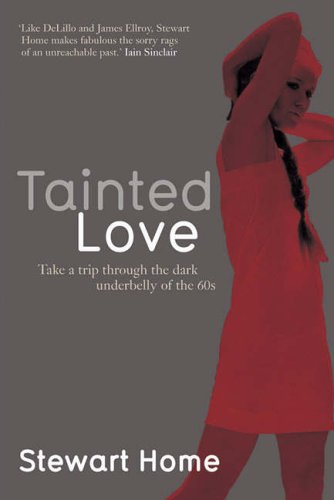
Stewart’s discoveries have formed the basis of Tainted Love (Virgin £7.99), which was the first book I read in 2006.
Tainted Love is a novelisation of the documents and anecdotes Stewart has managed to track down relating to his mother. This will obviously lead to some speculation as to what is “fact” and what is “fiction” (Stewart himself has desribed it as “thinly fictionalised”). Some reviewers have even gone as far as suggesting that the entire thing is (yawn) some kind of “situationist hoax” (why is that the SI are only ever seen as jolly student japers in some quarters?). Of course (as Stewart might say) fact is often stranger than fiction.
What is probably beyond doubt is that Julia Callan-Thompson worked as a hostess in various clubs in sixties London, which lead her into the whole “swinging sixties” subculture (as the “scene” was actually fairly small, contrary to its media image now).
This means that, fact or fiction, the story is a simultaneously humorous and bleak look at the legend of the 60s from an angle which is not normally given much attention. Lennon, Brian Jones and R.D. Laing make appearances in ways which should give some pause for thought for anyone who has bought into their legends. But this is not another kiss and tell offering for readers of Q Magazine and Mojo. More attention is paid to genuine underground characters like Alexander Trocchi (who had connections with the Situationists and has previously featured in issues of SMILE – some irony there) and Michael X.
The dark side of the 60s is expressed fully by the Krays and bent rapist cops, and by “Jilly’s” descent into heroin addiction after being forced to give away her son. As with Julia, “Jilly’s” death is surrounded by some worrying unanswered questions. The book begins and ends with some commentary by “Jilly’s” son “Lloyd O’Sullivan”.
I found the novel thoroughly enjoyable, and the back story pretty disturbing. I would thoroughly recommend it for both those reasons.
Also well worth checking is Tainted Love – The Art Rock Oedipal Folk Beat Mod Radio Show. An mp3 download of a Resonance FM radio show. It is a collaboration between Stewart Home and Nigel Ayers (of Nocturnal Emissions fame). Stewart provides text, Nigel reworks “folk tunes and hippie freakouts of yesteryear” into an excellent looping sound collage.
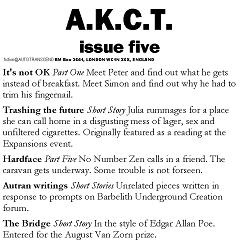
After something of an interval, the latest issue of A.K.C.T. is available for download as a PDF (along with all the back issues). Highly recommended fiction from a long-running comrade.
This issue covers psycho-commuters, filthly and verminous squat punks, git-hard zen buddhists, fucked up sexual relations and a whole heap more.
Get it from here.

KID SHIRT with some crucial Industrial archaeology: a great interview with Max on the story behind her and Alex Fergusson’s Dorothy whose “I Confess’ single which came out on Industrial Records.
Gustav Carrion was in charge of the Avant Garde and Experimental records section, in the upstairs part of the store.
Carrion despised the world. Most people were pathetic drones, going about their sad, humdrum, media-saturated lives, clueless as to the genius of Robert Ashley and Anima.
The 53-year old lit up a roll-up, and settled back to the strains of some prime Gordon Mumma, recorded back in the 1960s.
BEYOND THE IMPLODE (like you couldn’t have guessed!)
Nice post about Reggae, Eire and Irish music by Shane over at Cheebah and all that. It takes in Shane McGowan, that Eek A Mouse mp3, Tom Vague on Oswald Moseley and more besides. Check it!
Ms Infinite Thought should be aware that there is a precedent in this area. It has been alleged that no less than the Communist Party of Great Britain was partly funded by a franchise of Sketchley’s Dry Cleaners.