They were playing “Log On” by Elephant Man in Woolworths today. WTF?
kdubpunk
Me and K-Punk in agreement re: Mark Stewart. Good bit of text there, nice one. The stuff about not being embarrassed especially, is crucial, I think. It’s one of the cornerstones of alientation, isn’t it? The feeling that if you try and actually DO something which isn’t part of the prescribed list of acceptable work/leisure, that everyone will just laugh at you. And of course, maybe some people will.
Speaking of alienation I can’t believe Mark is still entertaining all that hogwash about femininity = capitalism. The original piece he refers to just seemed to be a very thin piss-take along the lines of “oh well women go shopping a lot so therefore an attack on women is an attack on capitalism”.
riddim
NOTHING HERE NOW BUT THE RECORDINGS
Ten industrial albums YOU must own.
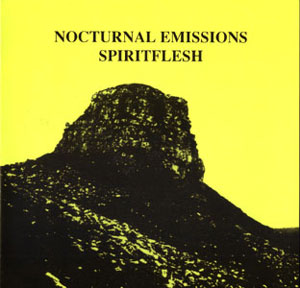
PART 3: Nocturnal Emissions – Spiritflesh (Earthly Delights, 1988)
 \
\
“‘Ambient’ means background music. My music shifts from background to foreground, so I wouldn’t consider it ambient. I consider what I do to be a subversive music, because it messes with people’s heads in unexpected ways.”
I think this selection may come as a surprise to many. It certainly did to me, but having listened again to many of the so-called “classic” industrial albums I found that many of them had utterly failed the test of time, whereas much of Nocturnal Emissions’ output was far far better than I remembered it.
The Noccies (as we will not call them) have an impressive history dating back to the late 70s. I think for many people (myself included) there was a tendency to dismiss them as yet another group who contributed tracks to every compilation going and who you would get around to investigating further… eventually. In retrospect this was to everybody’s loss.
In fact this is a key point – Nocturnal Emissions didn’t contribute tracks to compilations because nobody would release their stuff as an album, but because collaboration, networking, and participation in collective action was always a primary part of their modus operandi. As Nigel Ayers (the main, and mostly the only “member” of the “group”) once said of the early days of industrial:
“I see my own work in two contexts, one is for me to do the work I personally find satisfying and rewarding. The second is to undermine the structures of capitalism. So I have both individual and collective aims in my work. They may seem to be contradictory, but if you think about it, they aren’t. Whether I shared these motives with the ‘industrial movement’ is debatable. While many of the early industrialists dealt with ‘transgressive’ material, I think the effect has been that rather than public consciousness being raised, sado-masochism has become far more marketable. I think time has shown that the motivation for most of the so-called ‘industrial movement’ was essentially careerist.”
“The cultural phenomena that interested me, was a very much an ‘underground’ thing that worked through a number of informal networks of tape exchanges, squats, mail art, zines, etc. The ‘successful’ industrial bands had little to do with this phenomena, and instead participated in issuing the kind of ‘style sheets’ of correct listening, reading and thinking that you get in the Industrial Culture Handbook.”
It is also quite telling that Nocturnal Emissions’ output was never tainted with the totalitarian chic exhibited by many of their contemporaries. Indeed, whilst clearly being interested and involved in many of the diverse currents flowing through the underground, Nigel never let this detract from the music:
“Music is a means of communication. The point is to make it, to use it, to listen to it. Not to study or theorise about it.”
As with anarchopunk, many of the denizens of industrial culture collapsed under the weight of their own ideologies (or failing that, mythologies). Albums became impossible to just listen to* – the whole intellectual context had to be weighed up. Various industrial acts would announce in interviews that they were giving up music to work on books which explained their worldview – but none appeared.
It is somewhat galling, having waded through acres of cutting edge dark mysticism** as a young man, to find Nigel being so bang on and pragmatic from the outset:
“My record company advised me to emphasise the ‘magick’ side of my music, in order to sell more records. I know this is a strategy adopted by many of the other groups they distribute and it seems to work for them. Personally, I don’t know that I have an aspect to my life that isn’t magick or even magic. As a practising occultist, I’d describe my belief system as sceptical.”
Nigel is also slyly aware of being ahead of the game so many times over the last few decades that his past regularly comes back to haunt him. Most Nocturnal Emissions interviews are peppered with references to their influence on progressive or experimental music, which vary from the hilariously outrageous…
“In fact, every major musical movement in the past 20 years was all my fault. I am to blame for it all.”
…to pure statements of fact: Nocturnal Emissions were arguably the first group to use metal bashing, produced early “scratch video” before the name was coined, were cited as an influence on everyone from the Prodigy to Bjork and bizarrely seem to have somehow influenced the lyrical content of one of Boyzone’s biggest hits.
And so, without further ado, to the music. By the time Spiritflesh was released in 1988, Nocturnal Emissions had already produced several albums of electronic music which varied from noisy to funky. Displaying his usual perversity, Nigel chose to ditch electronic dance music immediately before the acid house revolution and produce a series of utterly compelling atmospheric albums which are often referred to these days as being “ambient industrial”.
Spiritflesh includes drones, birdsong and other recordings of animals, percussion, effects. It is by no means the assault on your ears that industrial music is supposed to be***. I am sure that if you described those elements to most people they would dismiss it as new age cobblers. In fact, the album is incredibly involving… enveloping. I think this is because Nigel is able to combine the white light of ambience with a darker undercurrent, so the whole carries just enough weight and intensity. Too little and it would be cheesy in the same way that the whooshing positivity of trance is cheesy. Too much and we enter camp “hammer house of horror” cliches or the outright nastiness of much of the industrial scene.
I’m reluctant to get into a track by track dissection. The album sucks you into its own world but allows you the freedom to wander about. It is easy to forget that nobody else was producing music quite like this at the time, because so many people have been producing derivative versions ever since. The original vinyl version will probably set you back about a hundred quid these days, but it’s been rereleased on CD in a variety of editions, including a “two for one” with the “Stoneface” LP (which I am ashamed to admit I have never heard).
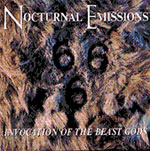
2ND CHOICE: Nocturnal Emissions – Invocation of the Beast Gods (Staalplaat, 1989)
 \
\
This was the next album after Spiritflesh and is in a similar vein, though more varied. I actually regard that as being a bad thing – Spiritflesh seems to work so well because of its similarity, its subtlety. It isn’t a serious criticism though because it still works really well as an album.
AVOID:
Nigel has produced so much stuff that I can’t pretend to be objective about the back catalogue taken as a whole. I just haven’t heard enough of it. There’s noise, glitch techno, drum and bass, “classwar anthems”, collaborations, even “avantgarde country and western”. I like everything I have heard, but I do generally favour the more ambient pieces – this is by no means everyones view, so make up your own mind. Your best bet is to head to the excellent Earthly Delights website and check out the mp3s.
FURTHER INFORMATION
The web site will tell you pretty much everything you need to know. Interviews, photos, discography, catalogue, it’s all there.
Also highly recommended is Network News, the occasional zine put together by Nigel. Contents vary from forteana and psychogeography, to excellent pulp fiction, to interviews, to reviews. Definitely worth a couple of quid for some back issues.
———————–
* Perhaps the best example of this was groups presenting their work as “research” and huffily stating that they should not be viewed as “entertainment”.
** Although this was useful to me for a whole swathe of reasons probably best not gone into here.
*** But check this, Nigel on his earlier, harsher, work: “My first records had birdsong, cat purring, sounds of weather, acoustic instruments only they were structured with different emphasis and perceived differently. I think ‘the media’ is an integral part of nature and real life, and real life has always been the source of my raw material. It’s just using it with different emphasis in different products.”
it continues to fade
Paul, also on Mark Stewart’s “Veneer”. I can’t help feeling that one of the reasons people like this record so much is down to their nostalgia for the time it came out? Which I don’t have as a johnny come lately…
So it’s 2 – all, then?
The Keyboard player is not Skip McDonald, though because they hadn’t met then – it was one of the mysterious people involved with all the early On-U stuff like New Age Steppers and whatnot.
Oh yes, and Danny writes to inform me that “Sounds of The Universe” (the Soul Jazz shop) now have a massive stock of old Tackhead twelves and the like, and demands I leave immediately for an urgent appointment with a barber in Hoxton. Bah!
Happy Birthday Ian Penman
Happy Birthday Ian Penman.
Some words of warning, also! Before consulting Crowley, remember his less than inspiring record with libel cases…?
a naughty bit of self-referential crap
Matt’s posting the Human League flexi about them discussing whether or not to release the flexi reminds me of Joel Biroco’s comments on the web:
“Most of the books in the world aren’t about printing presses and how to make books, yet the web contains a fair amount of material about computers and web design.”
And of course, many blogs have entries about this-thing-we-call-blogging. That’s novelty for you.
ace from outer space
human, all too human
Matt’s posted an audio clip of the Human League in curiously theoretical form. I must say I’ve never heard it and can’t be arsed, but the audacity is quite compelling. You’d never get autechre or any of other of today’s more “intellectual” electronic music producers releasing a track of themselves talking about producing music. Or would you? Prove me wrong!
Maybe Oakey and co were more interesting later when they’d ditched the Heaven 17 contingent and embraced pop. They certainly gave good account of themselves in this classic dust up between the Human League and Throbbing Gristle.
Much as I respect and have been influenced by Genesis P-Orridge, he don’t half come across as an elitist here.
skykicking
Some good stuff over at skykicking on bashment. (It’s the august 1st entry, the archive linking seems to be mashed up).
Pretty bizarre to talk about bashment in terms of “albums” though?! Seems peculiarly rockist. Riddims and sevens, mate! Riddims and sevens!
Sean Paul works best when mixed up with Elephant Man, TOK and a host of others on a killer riddim. If you do that, then his good looks and tones only act as one colour in a pallette of others which include Elephant Man’s gruffness and TOK’s harmonies… or whatever.
It’s true that SP has been elevated by the music business as being a star in his own right, above everyone else, and this includes strategies like not including his cut of Diwali on the one riddim LP (which did include Wayne Wonder). But that doesn’t mean that people will see it like that. Indeed, perhaps seeing it like that is a trap we should actively avoid.
“Higher Level meanwhile is one of the most addictive, consistently engaging albums I’ve had the pleasure of hearing this year, its near-kaleidoscopic array of sounds and grooves lending the album a near-definitive feel, as if this album could stand in as a representative for where exciting pop sonics in general are at right about now. Certainly I’m tempted to cheat by making it in my top five album list for the year, despite it coming out in late ’02.”
Without being a total pain the arse spotter, “Run For Your Life” (with Jarvis Church, which he quite rightly gives a righteous poptastic thumbs up) came out on seven in 2001! (Same label as the Nelly Furtado tune which is the penultimate track on my mix).
“Crucially though, there’s a real sense that this music could go (is going) in a hundred directions.”
Amen.