poor marcus

rereading Marcus’ post again sober, it’s clear that William Bennett was actually talking about what HE personally wants to get out of Whitehouse (his own pleasure), so I was wrong to suggest he was concerned about evoking a particular feeling in his audience – though the feelings that people had were discussed.

\’c5\’ed\’e4\’cc\’e1\’ed\’d3\’ca\’c7\’e4 b l o g

Keep forgetting to mention the man Ed Inglistan whose blog and site are… um. Well, a bit mad and compelling, basically.

Ed has also sent me an outstanding CD of reggae stuff including a recording of an absolutely wicked Luciano dubplate played by Abashanti.

Check it. Serious open-ended fanaticism. It’s a London thing, in the loosest possible sense of the word (and then some). People get lost in this site and never come out…

just get down on your knees

A whole bunch of stuff about Whitehouse, of course. Bit futile me saying that this was an issue not worth spending much time thinking about, eh?

I can see where Matt is coming from, because my interest in Psychic TV and industrial culture stemmed from my rejection of religion (tho I “only” went to Church every Sunday). We can get bogged down in a discussion about the motivations of people involved (i.e. the transcendental vs wallowing in the badness) but all I really have to go on is my own experience.

Quite tellingly a lot of people I know immersed themselves in that stuff and came out the other side OK, without feeling the need to stay there in perpetuity. So I regard my involvement with T.O.P.Y. as being something of an apprenticeship – a precursor to other stuff. I\’92ve been thinking about this quite a lot recently because I’ve been asked to do a talk on it next year, which will be an exercise in score-settling, ego-masturbation and contextualisation. Heh.

Ingram, Luka and Mark all seem to think it’s important to discuss artistic responsibility and I don’t see the point. Surely artists, almost uniquely, have a duty to be irresponsible? To provide a bit of danger in an increasingly sanitised world? Why “must” art always be about making the world a better place? And who decides whether people’s intentions are pure enough?

I remember interviewing Andy Martin of Academy 23 about getting into industrial stuff and he said it was the first music which actually meant anything to him. The alternative at the time was Abba who banged on about love and how great it was to be rich, whilst his experience was coming from a desperate family situation, being sectioned, being harassed by the police and basically feeling pretty pissed off with life. So, for him, Throbbing Gristle came as a total validation of his existence in a way.

Mark makes a good distinction between “shocking” and “disturbing” but I can’t help but feel that the latter is merely a more sophisticated version of the former. Whitehouse are modelling themselves on something completely anti-social and yet they are reaching out to the public by dint of releasing records and performing. Clearly people involved with the activities they glorify do not publicise them, and will go to enormous lengths to ensure that nobody else knows about them. So it cannot be the case that Whitehouse, in reality, are indifferent to people and their responses to their work.

I also received a fascinating email from Marcus at Rephlex last night, which I must confess I read when I was pissed, so it’s all a little hazy. (Marcus,  sorry to be so crap at responding to emails. Big up ya status!)

Marcus recently attended a talk by William Bennett (and I think Phillip Best) about Whitehouse’s work. Which is clearly a shift – a deliberate attempt to engage with the audience. It sounds very interesting and from what I remember in my hungover state, Marcus got the impression that Bennett was very interested in the audience’s reaction and was in fact on a mission to evoke a particular response in them (i.e. fear/danger/liberation). The question then is – does that take power away from what Bennett is trying to do (a recognition that the game is up after 20 years?)

I do take Mark’s point about fascism being a trap – mere human politics, compared to what Whitehouse are attempting. (In fact I remember them doing two tracks: “BirthDeath” and “Politics” which both consisted of nothing – silence.). But as a part of the rejection of fascism comes a commitment to “libertarianism” which, although vague, is still some kind of (moral?) framework. Far better (from the point of view of cultivating a mythology) to not come down on either side of the fence, I would imagine. Death In June (and their clones) have made a successful career about being ambiguous about fascism.

Coming back to the religion thing, I think the precise point that Matt was making was not that Whitehouse were “anti-religious” (which I would take to mean a completely materialist, rationalist, atheistic worldview) but that they represented an “evil” form of spirituality – an inversion of the white light of xtianity.

and another thing

Bang Out of Order is one of the best things I have read on the subject of Power Electronics and I may scan it in one day for your reading pleasure.

It concludes thusly:

“This publication is dedicated to the ultimate power electronics chancer, John Murphy. At the same time as being an integral player in the original scene, working with Whitehouse and Consumer Electronics as well as his own Krang project, Murphy also played drums for chart pop act The Associates : ‘… the drummer would mooch around Morgan Studios in a dirty old raincoat with a William Burroughs paperback poking out of the pocket…’ – The Glamour Chase: The Maverick Life of Billy Mackenzie, p62. Under capital, the only honest approach that can be made towards art is through show business.”

you don’t have to say please

Dealing with the k-punk piece first of all (Monday June 30th 2003 entry).

He’s right when he says that Whitehouse’s attraction lies in the fact that they refused any explanation. It is precisely this mystique and nothing else which has lead to their success.

As the Sotos piece at uncarved (linked below) says, to become a fan of the genre you have to suspend your disbelief and uncritically take on board what you are being told.

Which in the case of Whitehouse is that there exists an underground network of sexual fetishists who derive pleasure from violence and have an accompanying philosphy which is expressed through the music.

On one level there is a sophisticated black humour involved with this process, something which isn’t always picked up on by critics and more idiotic fans of the genre.

However, inevitably, Whitehouse do end up “explaining” their existence. Sometimes by necessity and sometimes by accident.

William Bennett is especially keen to dispell rumours of fascism, for example:

Do you think that, because of album titles like “Buchenwald” there’s a danger of Whitehouse being seen as a fascist group?

WB: “Oh there are enough other groups who present such a strong image. I’ve never expressed any political opinion. So I don’t think Adolf Hitler would have been a Whitehouse fan, I can’t imagine him playing a song like “My Cock’s On Fire” at home. I’m convinced that in a fascist state Whitehouse would be one of the first to be put up against the wall and shot, so it’s really impossible to misunderstand us as that”

[from p64 of the Whitehouse “Still Going Strong” anthology which was published by Impulse in 1993]

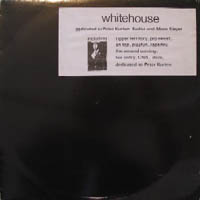
These “misunderstandings” no doubt partly fuelled by Whitehouse records entitled “Fur Ilse Koch”, “New Britain” etc and Come Org re-releasing “songs and marches of the SS and SA”, Himmler speeches…

One can’t help but feel that these denials are to ensure self-preservation – to avoid attention from the state and from anti-fascists. But they are also a classic example of the mythology collapsing: “oh yes, we are completely amoral, but of course we aren’t fascists” has to subtract from the glamour.

Another example would be of Whitehouse associates just over-reaching themselves. The “Come Ultra” videos were billed initially as “Snuff Films” or “the torture and execution of cats and other animals” or simply “brutal and violent”. However the mastertapes were (cough) mysteriously “stolen” and so this material never saw the light of day.

However a video was released which I saw a copy of some years back, featuring live performances and some unintentionally hilarious interviews with Whitehouse personnel. The main thing I can remember is (I think) Kevin Tompkins being interviewed in a surburban street about his obsessions with murder, death, sexual violence etc. I guess the intention was to portray a sinister loner who could be anywhere (next door?), but this effect was ruined by Kevin coming across as your spoddy mate who reads too much about serial killers, and a milkfloat going about its business in the background of the shot. It had the feeling of naughty school kids trying to out-do each other.

It is precisely the point at which the mythology breaks down which is instructive, not only about power electronics as a genre, but about figureheads and the media in general.

Turning now to Matthew Ingram’s piece at Hollow Earth, I think the first thing we need to do is to distinguish between the various players in the Industrial genre.

Most of those he mentions (C93, Coil, NWW, TG) have an appreciation of the darker side of human behaviour and nature – as something to be explored rather than repressed.

TG and PTV’s emphasis was always on a “deconditioning” a way of investigating your darker side as way towards self-transformation – a way of escaping alienation. Certainly this was an approach I found useful and whilst some of the people I met on the way were devoid of positivity this was not the case with the vast majority, many of whom I would cite as being powerful forces for good in the world (or at least, in my life) to this day.

Coil and Current 93 are both difficult to slot into this, but the former are certainly people I have associated with trying to develop their own aesthetic, who would like to make a positive difference in the world (in fact, embracing causes such as the Terence Higgins Trust when it started in the early 80s, and various light pollution and environmental issues more recently). As for David Tibet, what I can make out of his philosophy is that it is so hugely, cosmically bleak, that the petty fleshy stuff that Whitehouse deal with is an irrelevance to him.

And as for Nurse With Wound, I refer you to “The Sylvie and Babs Hi-Fi Companion”.

There’s a danger with all of this of over-moralising and I must confess to drawing in a sharp intake of breath when Matt starts chucking around words like “Holy” and “Evil”. It simply isn’t the case that any of these people in (goddammit) pop groups are important or influential enough to cause any harm.

People might not like it, but the suggestion that music/art/work should not deal with “the dark side” is profoundly troubling.

It is of course tragic that there are victims of sexual violence out there and it is tragic that we live in a society which perpetuates this sort of abuse. But it’s too easy to believe that Whitehouse are in some way the architects of this. A more appropriate term would be “cheerleaders” or simply people trying to gain a bit of notoriety by flogging some records (including sending them to completely disinterested tabloids). To believe otherwise is to massively over-estimate their relevance and importance.
cold hard black

Ingram tears into Industrial Culture. Cos K-Punk are revisiting Whitehouse.

In a sense he is covering similar ground to that trodden on at uncarved.org:

Rants on Peter Sotos and The Church of Satan, plus reviews of Esoterra and Compulsion.

Industrial Culture is a fond part of my past, but it’s impossible to remain uncritical of it. Many of the points Matt raises are bang on, but I can’t feel that he is approaching it as an outsider and therefore tarring everyone with a big sticky black brush.

So for example it’s obviously fine to say that he has never got into any of the music, because in many cases the whole point was the mythology behind the music anyway. The fetishisn of owning rare records and knowing that a certain LP was recorded down a haunted mineshaft in siberia or whatever.

It’s also correct to be critical of the unrelenting bleakness of it all. Like a lot of people I’ve always seen this as a very superficial take on Throbbing Gristle, the godfathers. It’s true to say that TG were bleak and looked into stuff like murder, mayhem and so on, but they were much more than that. Similarly, their music cannot be dismissed as being distortion and shouting.

But those that followed often picked up on some of the very linear and one dimensional aspects of what TG were doing. Whitehouse are probably the best and most successful example of this.

That said, the value of Whitehouse lies in their extremity – as representing a pole of sheer over the top hatred and ugliness (an all out attack on liberal values). But that doesn’t mean you have to listen to it more than once, or even spend very much time thinking about it.

More later.

dub side of the moon

I know we’re all supposed to be uber cool in the blogging community, name checking obscure 80s electropop b-sides and holding forth about what’s on the pirates. But…

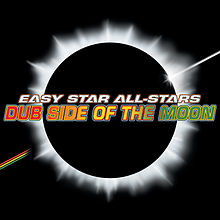
I’m slightly embarrassed to admit that I do not hate the reggae version of Pink Floyd’s “Dark Side of the Moon”.

I mean, yes, obviously I hate the very idea of post-Syd Floyd, with all their coke-addled indulgence and middle-class-guilt and muso-ness and all that. (innit).

Which is probably why I have studiously ignored them, apart from listening to “The Wall” about twice (love the cartoony bits in the film by Gerald Scarfe as well) and “Moon” I think I have heard about once in my life.

So when a mate at work bunged me a copy of the reggae CD, I put off listening to it for ages. But it’s… alright, actually. Frankie Paul’s on it, nice production (on the clean side, but not sterile), some nice sound effects (not dubby enough, but OK).

It’s interesting that reggae-heads who seem to like it are the ones who have little conception of the original LP. Possibly because die-hard Floyd fans aren’t usually die-hard dub fans, which means some people are trying to escape from their hippy pasts…

What’s confounding is that it’s a godawful idea, that shouldn’t work, that it should be easy to slag off… but y’know, it’s worth checking. Definitely make a good present for someone’s stoner mate who is into Pink Floyd and likes the idea of dub…