Pseudo Skins!

“Pulling on the boots and tightening up the laces
Shaving their heads and strapping on the braces
There you are a skinhead, looking for a fight
Skinhead, skinhead, running through the night

Skinhead, skinhead, running through the night
Making lots of trouble, starting lots of fights
Skinhead, skinhead, getting really pissed
Skinhead, skinhead, tatted on my wrist!”

An Oi song from the film Romper Stomper. A remarkably authentic one, in fact, despite the vocals being delivered in a kiwi twang rather than yer actual cockernee and the abhorrent racism in one of the verses. Many people would be surprised to know that the song wasn’t actually by a “real” Oi band, but was composed by John Clifford White and performed by “The Romper Stomper Orchestra” who also did the more atmospheric/classical musical elements of the film.

Both Romper Stomper and the similar American History X were hugely misunderstood by both the extreme right and the supposedly revolutionary left.

On the one hand, nazi boneheads bemoaned their portrayal in the films for various minor reasons, and berated hollywood for not having the “guts” to use real “white” “power” music in the films. (It needs to be restated that “white power” music is a completely retarded concept which I guess given its fanbase is only too fitting. First of all it should go without saying that the music’s roots are in rock ‘n’ roll which is hardly Wagner, is it? Secondly the whole concept of “white power” is redundant. The last time I checked, virtually every person who had any power over me, whether in my job, or in terms of world, national or local politics was white through and through.)

On the other hand, supposed revolutionary socialists (in the guise of the SWP front group the Anti-Nazi League mk 2) organised pickets of cinemas showing Romper Stomper on the grounds that it glamourised nazism.

Both films show boneheads as almost completely without redeeming features, doomed to utterly wretched lives and violent deaths. Only a total fantasist would see any of this as worth aspiring to, which probably says more than enough about both sets of critics.

Having said that, perhaps the “bogus” nature of the Romper Stomper soundtrack isn’t actually all that surprising. For a scene which is riddled with demands of supposedly “authentic” white working class culture, Oi (and its degenerate nazi offspring) has seen a fair few sta-prest magpies in its nest.

In terms of nazi boneheads, Stewart Home’s Cranked Up Really High: Genre Theory and Punk Rock notes the privileged upbringing of Jonathan and Paul Bellany aka Burnley as the sons of a reknowned painter. But enough about those with stiff right arms, we have bigger and more interesting fish to fry here…
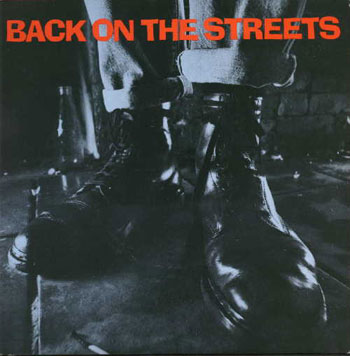
The Back on the Streets EP was compiled by Garry Bushell and released on Secret Records (with distribution by Virgin) in 1982. Unfortunately I haven’t got a copy, but that’s never stopped me spouting my mouth off before so I don’t see why this should be any different. It looks like your standard punk/oi various artist EP – DMs, a bit of pavement, superb band names like “Angela Rippon’s Bum” and classic track titles such as “Where’s Dock Green” and “The Way It’s Got to Be”.
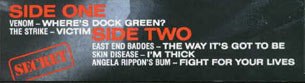
Of particular interest is the group Skin Disease, whose track “I’m Thick” features lyrics consisting in their entirety of the title repeated 64 times. The group were based in Burnley and had been in correspondence with Bushell in his capacity as Oi-cheerleader at Sounds for some months. Bushell covered them in the paper and invited the northern oiks down to London to record the track – their first (and it turned out, only) outing on vinyl.

Some months later it turned out that “Skin Disease” were actually a spoof Oi band formed by Chumbawamba (before they had released any of their own material on vinyl):

“We used to write leters to Garry Bushell, we got a good dialogue going with him. We hated everything he stood for, the letters were full of bullshit saying things like ‘we’re a skinhead band, one of us is in hospital after breaking his leg against a policeman’s head and that kind of thing. It was just for the joke of seeing what Garry Bushell was into. He took it all in and wanted us on the next LP. “

“We were in a dilemma because we wanted to parody the whole Oï thing, and we had planned to go really over the top on the macho-violent theme , but some people may have taken it seriously, so it ended up as ‘I’m Thick’ repeated 64 times. “

(Interview in Maximum Rock’n’Roll #14)

For anarchists like Chumbawamba, parodying the reductive working class images portrayed by Oi makes perfect sense. For a multinational corporation to use skinheads in a postive way as part of their branding strategy in the early 80s makes no sense whatsoeover. But that is exactly what Weetabix did.

“Just one titchy bit of toast?
We gotta put them straight
We’re the weetabix (yeah!)
We don’t like breakfast fit for sparrows
Nothing to ’em mate
We’re the weetabix!”

“The Weetabix” made their debut in TV adverts for the hugely successful breakfast cereal in 1982.

They were:

Dunk (the leader)
Crunch (the muscley one)
Brains (the, uh, brainy one – you can tell that because he wore glasses)
Bixie (the girl, clearly and unambiguously signified by her eyelashes and bow, because that is the essence of the female form, is it not?), and
Brian (who I think was the token “little kid” in the gang. His role was mainly to shout “OK!” in an annoying voice – presumably inspired by the bloke of out Madness who would shout “Oi!” and other stuff in the manner of JA deejays)
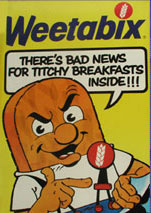
The gang were dedicated to the extermination of “titchy breakfasts” and there was a distinct hint of the old ultra-violence in their “If You Know What’s Good For You” catchphrase. In the early 80s the skinhead cult was huge, and associated with all sorts of yoof-culture moral panic in the tabloids. Which means this ad was either an astute way of winning the target audience’s hearts and minds, or some kind of bonkers coke-fuelled recuperative initiative aimed at clawing back sales lost to accursed rivals such as Quaker Oats and their Honey Monster.
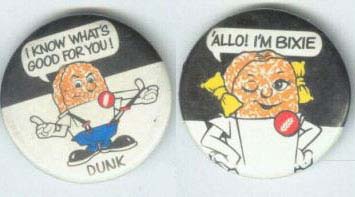
The inevitable merchandise deluge followed shortly after, with badges, mugs, bowls etc. Whilst discussing this piece with my parents I was hugely excited to find that my Dad still has a “neet weet” t-shirt to do the gardening in.
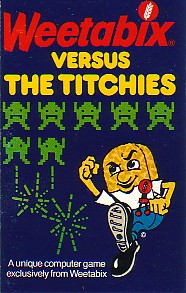
The gang even appeared in their own computer game, although actually this isn’t saying very much as anyone with a hint of media presence had their own computer game in the 1980s. The Thompson Twins had a particularly shit one for the ZX Spectrum if I remember rightly.

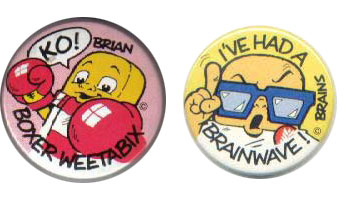
Perhaps inevitably the Weetabix Crew’s righteous proletarian credentials could not withstand the glare of media attention. Maybe the Weetabix advertising agency got cold feet, or maybe the fame went to the Bix’s heads as with so many working class kids thrust into the spotlight before them. A set of badges produced after those shown above were notable for their lack of aggression – or braces:
As their fame grew, so did the budgets. The gang got to meet Harrison Ford in an “Indiana Jones” film tie-in, and later hooked up with Spielberg via ET. Towards the end of the decade, their style had evolved to take in breakdancing and electro, but it was clear that there was some rewriting of history going on at Weetabix which would eventually spell disaster…

In the depths of my brain is a memory of Steven Wells ringing up Weetabix as part of an NME feature on youth cults and being told firmly that the Weetabix Crew were not skinheads and had never been skinheads. It is this sort of revisionism that lead to this horrific book cover:

The crew, once proud street hardened youths used to “having a laugh and having a say” are now reduced to pantomime dames for the delectation of The Man and his sales figures. It is no surprise that, after their triumphant reign throughout the 80s, the Crew were replaced by another pantomime dame in the safe, traditional form of Robin Hood for Weetabix’s first ad campaign of the next decade.

Nowhere is the class basis of UK society more evident than in the subsequent trajectories of the crew. Weetabix had auditioned a plethora of aspiring actors for the roles, but all of these, with one exception, had failed to live up to the streetwise image the company was seeking. The majority of the gang were picked up by talent scouts fresh from the streets and schools of Crawley, a “new town” 30 miles south of London.

After his 15 minutes of fame, Crunch returned to working the doors of London clubs and pubs. He did some time for ABH during the 90s (he maintains to this day this arose from a case of self-defence), which gave him the opportunity to study for a degree with the Open University.

Brains set up his own business flogging mobile phones by mail order, but lost everything he earned through an ill-advised start up company in the early 00’s. He now works in retail, and has become a Jehovah’s Witness.

Bixie is now a mother of four, who still lives in Crawley. She sometimes appears as a “vox pop” in 80s nostalgia shows, and was nearly shortlised for last year’s “I’m a Celebrity – Get Me Out of Here”.
Dunk was always the odd one out of the gang. His father was a high ranking diplomat, which lead to Duncan growing up in Pakistan, Thailand and Hong Kong. He later studied at RADA and was quite successful as a bit part actor in west end theatres.

Duncan was placed to appear in a small speaking role in a prestigious production of “As You Like It” at the RSC when the Weetabix contract loomed. He is now the executive director of several highly successful media consultancies. His past clients include Glaxo-SmithKline and Sony. He is said to have worked for the office of Charles Kennedy during this year’s general election. He owns several houses in Gloucestershire, Barcelona and New York state .

Brian’s story is the saddest of all. As the youngest of the group he was the least well equipped to deal with the demands of fame and fortune. After the gang was disbanded, he went on to sign a lucrative modelling contract, but later went seriously off the rails – spending all of his royalties on drug binges and extravagent parties. His Mayfair flat was repossesed in the early 90s after some irregularities with his taxes.

After a spell in rehab, Brian tried to drum up interest in a number of doomed projects. His proposal for a kids’ tv show “Brian’s Neat Wheat Rumpus Room” never made it to the pilot stage. His solo recording contract with WEA floundered after a number of (often violent) disagreements with record producers. Brian was then reduced to singing for his supper (or rather, repeating his “OK!” catchphrase ad infiintum) at soul-sapping PA’s in students unions and mecca ballrooms.

After a particularly badly received appearance at Shades’ nighclub in Leighton Buzzard, Brian was seen wandering down the central isle of the A505, clothed only in his trademark football scarf and DMs. Despite clearly being in a state of distress, he was banged up for the night at Dunstable police station before being discharged the following morning. Two days later, the remains of Brian’s dead body were found in a cheap hotel in Hastings. He had committed suicide by drowning himself in a bowl of milk.

Since then skinheads have largely faded away, with the occasional Ben Sherman shirt and sideburns testament to a raucous youth. You’re much more likely to find boots and braces down Old Compton Street than anywhere else (or down Carnaby Street as euro-skins search desperately for times long gone).

Standing in Victoria Station yesterday, two twentysomething skinheads walked past with Cock Sparrer t-shirts, turn ups on their jeans and “England” tattoos on their heads. They couldn’t have looked more anachronistic if they’d been turned out as teddy boys…

London Live Emissions

H I N O E U M A the M A L E D I C T I O N proudly presents:

A rare and special line up!

A festival of industrial music, experimental noise, power electronics and conceptual music art with some of the best artists in the field coming from the old and new school industrial scene.

Saturday 26th November
[in conjunction with Termite Club annual festival Leeds] at Slimelight

with ::

NOCTURNAL EMISSIONS

Z’EV

MK9

SEKTION B

FUKN’ BSTRDS

live action from 8.pm to 12 am with free entry at Slimelight club after the gig till 7.30 am!

Venue: Slimelight: Torrens Street, Angel tube. London Ticket price

£8.conc.9.ADV 10 at the door

http://www.geocities.com/hagshadow/novemberfest2005

Not sure about the rest of ’em but I would gladly pay 8 quid to see either Z’ev or Nocturnal Emissions. This should be excellent.

Roll Like A Thunder Vol 1

Oh… my… gosh! Selector!

Per has produced an absolutely stunning 80s (for the most part at least) dancehall mix for you to download over at computerstyle.org.

This is outstanding stuff, HUGE riddim excursions on diseases, hot milk and real rock. It’s made a tedious night in front of a database a pleasurable one.

Muuuuurder style!

Punk Comics 4

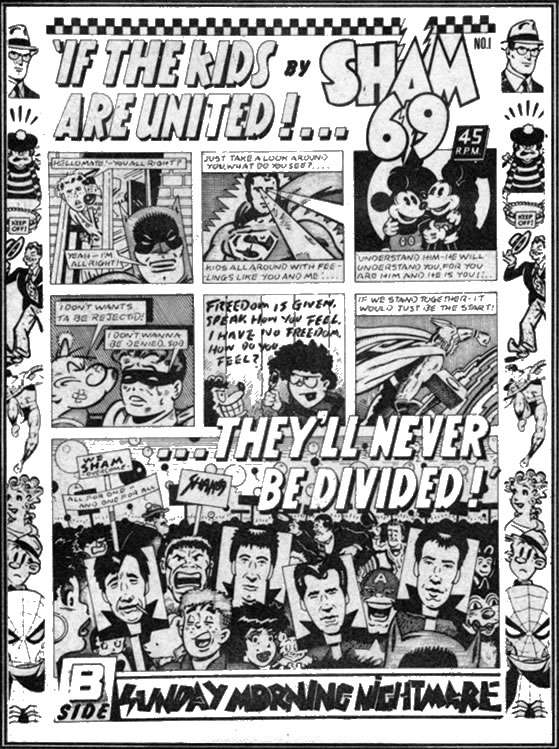
Blah blah detournment detourned, innit. The only interesting thing about this artwork is whether or not the record label got copyright clearance for the use of Batman.

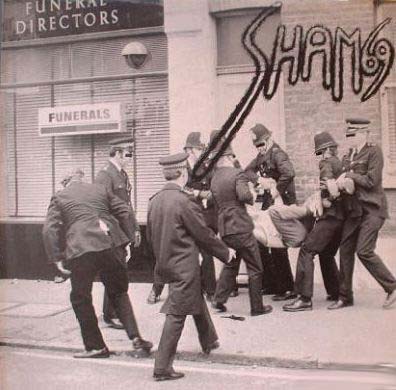
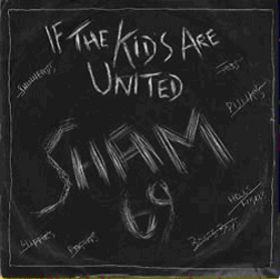
Perhaps Sham’s recent appearance at the Labour Party conference wasn’t so surprising after all. I mean, it was only last year or so that “If the kids…” was used by McDonalds in a TV advert, so it’s hardly a quantum leap from that to the mcpolitics of nu-labour.

As Martin has pointed out, perhaps we have to look elsewhere for our punk fix now.

That tune, though… it gets hold of you…

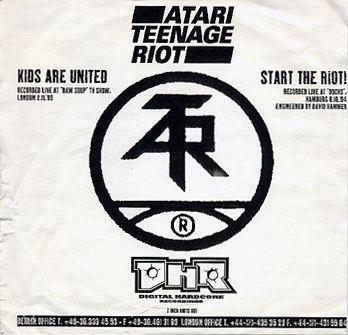
This 7″ came out in mysterious circumstances in 1995. One side has a totally white label, the other side has a totally black label.

The “white” side starts off with this fantastic interview with Atari Teenage Riot conducted for the “Raw Soup” tv show:

Alec Empire: “There are so many things are wrong with the system… that’s enough.”

Interviewer: “Enough to cause a riot?”

Alec Empire: “We need a change.”

Interviewer: “And finally, how do you relax after a hard day’s rioting?”

Hanin Elias: “I don’t relax. Ever.”

The record then cuts into a brutal live Digital Hardcore version of “Kids United” which used the Sham refrain but adds lyrics such as…

“You know that violence is a disease
It’s going to be a part of our lives and our future if we don’t do something against it!
But if we put our energies together it could be a very powerful era!
Riot sound effects can produce riots
Play them in a riot situation and the police will come you’ll see!”

…which owe as much to Burroughs circa The Job as they do to punk.

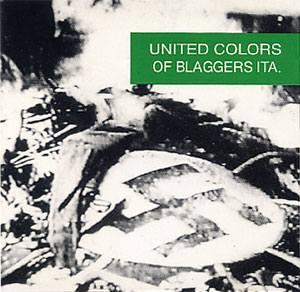
The Blaggers ITA are one of the best bands ever and “Emergency”, the last track on this classic album, is one of their best tracks ever. Why?

Well, it kicks off with Madonna saying “You can dance – for inspiration” before bringing in some excellent horns, drums, bass and guitar whilst Matty Blag sings about the cops:

“999 on the telephone / 999 coming in my home”

Matty continues for a few verses, before the bridge to end all bridges, a mosh section, a HUGE horns and bass and drums section and then Christie comes in with some top geordie toasting business:

“Shout down the road and we’re all gonna come,
found all the nazis and we’re gonna make ’em run,
we’re all tooled up for a knuckles-to-the-ground,
there ain’t no place for a nazi in this town.”

Christie’s verses end with an impassioned dedication:

“This is for all the prisoners in jail,
all the people who’ve been jailed for being anti-fascists,
this is for David, Mark and Tony,
serving time for fighting against fascists,
fighting the right fight,
fighting the just fight,
fighting against them scum!”

The Blaggers were not fucking about with politics like most pop groups – their involvement with the militant “physical force” Anti-Fascist Action meant that they’d almost certainly had personal dealings with people who had been sent down for confronting nazi boneheads on the streets. The song then launches itself into a raucous terrace chant version of “If the Kids Are United”…

I’ll take that over Tony and Gordon any day of the week…

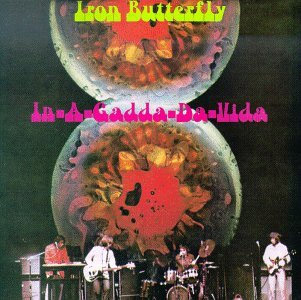
The occultural roots of “Inna Gadda da Vida”

From the official band biography:

In July of 1968, Iron Butterfly released the monumental LP, In-A-Gadda-Da-Vida, featuring the 17:05 minute side-long track that shook the entire music industry with its phenomenal reception. ‘Vida outsold every record in the history of recorded music within the first year of its release (over eight million copies sold) and therefore outgrew and outsold the standard of the music industry’s “Gold Album” award. For this achievment, Iron Butterfly was subsequently awarded: The Industry’s Very First “Platinum Album”! This historic award was created and presented by then-president of ATCO Records Ahmet Ertegun, who went on to become the current CEO of the WEA Group.

There has been much speculation regarding the origins of the title of the track and after a bit of digging I have uncovered some details which may surprise even the band’s most ardent admirers. First of all, a little background is needed:

In the summer of 1959 avant garde artist Brion Gysin invented the cut up method whilst staying in the notorious Beat Hotel, 9 Rue Git-le-Coeur, on Paris’ left bank. This technique, by which texts were cut with scissors and then reassembled in a new order, was later popularised by author William Burroughs. Burroughs found that many of the “new” texts he produced out of cut ups seemed to refer to events which later actually occurred in real life. He described this as letting “the future leak through”.

The title “In a Gadda da Vida” is usually credited to singer Doug Ingle being (it is alleged) mashed off his tits on drugs and mumbling “In the Garden of Eden”.

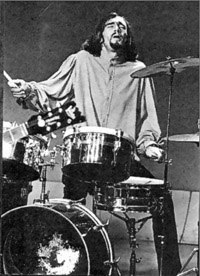
However another version of the story is that the title is in fact down to drummer Ron Busby. Ron was one of the less notorious visitors to Gysin and Burroughs at the Beat Hotel in the 60s. As with many drummers of the time (and since) he had delusions of creative talent which were beyond his scope.

On returning to San Diego, Ron began experimenting with Gysin’s various techniques, constructing a dream-machine in his downtown apartment, playing The Master Musicians of Jajouka LP released by Brian Jones at all hours of the day and going crazy with a “prepared” paint roller. His cut ups were spectacularly dull, even when compared to the rest of the genre.

It is rumoured that the phrase “In a Gadda Da Vida” was the result of him cutting up an interview in “Time Magazine” with hairdresser and veteran anti-fascist Vidal Sassoon. (Sassoon was a member of the militant anti-fascist “43 Group” comprised of jewish ex-servicemen who had fought for England in WW2 only to find Oswald Mosely’s fascists on the streets of the east end when they returned to London. The solution to this was simple: militant physical confrontations at their street rallies. As Sassoon later put it “We beat them because we hated, and were more ruthless.”)

Busby is rumoured to have laughed for days about the hilarity of “cutting up” an interview with someone discussing cutting hair. The rest of the group took pity on him and used the title for what is probably their most famous track. The tune was later covered by everyone from the Incredible Bongo Band to thrash metallers Slayer, and played a key role in the film Manhunter (the precursor to Silence of the Lambs).

In a strange quirk of fate, the title did actually “let the future leak through” in the early 90s when Holland fell under the thrall of the dance music revolution.

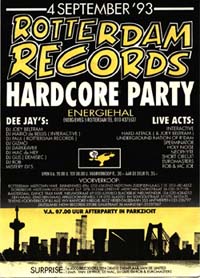
In Rotterdam especially, the sounds of techno artists like The Mover and Second Phase were hugely popular and it wasn’t long before the city spawned a bewildering array of producers (3 Steps Ahead, Drokz, Annihilation, Rotterdam Termination Source, etc) of home grown ‘ardkore.

As with all scenes, exclusivity and tribalism were the order of the day in its formative stages. A line was drawn between those involved – and everyone else. Huge amounts of venom were directed at rival city Amsterdam and producers such as Paul Elstak who were perceived as selling out. The scene developed its own style, fashion and language alongside the music.

Ravers in Holland were typical working class kids, well used to blagging, brushes with the law, and bouncers excluding them from nightclubs. The term “gabber” or “gabba” is said to be derived from the Yiddish word khaver, meaning “friend” (or rather “mate”/”blud” etc) which was used by kids in the Netherlands. Apocryphally, the term sparked an entire genre when one kid wanted to enter a club in Amsterdam, where the bouncer said, “No gabber, you can’t come in here.”

In exactly the same situation in the UK, a member of the Kemet Crew was refused entry to a club which was actually playing one of his own techno productions at the time for looking too “ragga”. In both countries, the excluded were inspired to create their own music and clubs, consisting of a “roughness” diametrically opposed to the “smoothness” of mainstream clubbing.

“Inna Gabba Da Vida” became a key phrase in the early days of Rotterdam hardcore, mashing together Jamaican patois, yiddish and spanish. It displays a positive mongrel attitude completely natural to urban working class youth – used to living and working cheek by jowl with people from all over the world (something which isn’t always the case for middle class liberals, it has to be said).

Basically translating as “Hardcore For Life”, the phrase appeared on club flyers and record labels as a badge of credibility – a badge that could never be worn by “weekenders” or by “smooth” clubbers.

Dub Conference @ Plastic People

dubconf7

Bigfoot

I seem to have inadvertently deleted the post bigging up the Dub Conf night at PP, but it was worth checking. Hello to those of you who came down.

The night kicked off with some nice low level roots courtesy of Channel One which was a good warm up because you could still speak to people. Mainly UK productions being played as far as I could tell but also some quality Sizzla on the roots tip. Some things to track down, notably a tune which involved words along the lines of “one stand firm, two means a fight on your hands” or something like that.

I guess Bigfoot from Station FM [pictured above] probably took to the decks at about 11pm and played a mainly female vocal selection which I thought was pretty brave, really. It seemed to pay off though and he ran some nice Sister Rasheda selections and fair play to him for trying to broaden things out rather than stick to what people expect. By now Plastic People’s soundsystem was warming up and the dancefloor was filling up. Bigfoot ended his session and Channel One returned, much to the delight of their home crowd of warrior steppers. Things blew up from there but I had to leave about 12:30 cos I knew today was going to be one long eyestrain as I vainly tried to reassemble clauses and sub-clauses in The Bastard Document.

Overall a good first night with a very relaxed and untrendy vibe for Hoxton check the Roots Studio website for details of future events- there’s one on at Electrowerkz next week with 3 Dimentional Roots & Mighty Tabot in session, for example.

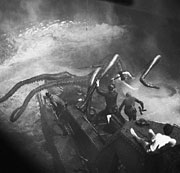
Squids In


seamonster

Respect all comments box cru [1], [2], especially those who know the difference between “giant” and “colossal” and have realised that models are models of something. And hello to everyone who linked here and/or spread the squid-horror-virus by downloading or linking to the image.

It’s fair to say that Squid Mania has swept the world in the last few weeks, so here are some links for y’all:

Kid Shirt blog now upgraded to New! Improved! Squid Shirt with added sub-aquatic mania.

Check this awesome flyer for Komische by Jim.

Also the obligatory (and essential) comments from Martin and The X.

Plus some up to the minute news on the Giant Squid (NB, this is not the same as the colossal squid, oh sceptics!) and its hugely violent sex life.

Watch the seas, people…

if the kids are… de-hooded? consulted?

new labour sham

“Everything was perfectly in place: the red velveteen backdrop, the multi-ethnic cast of Labour supporters positioned on the platform, and a speech balanced delicately between rousing celebration and the floating of new, explosive ideas. But who, in the long hours leading up to Tony Blair’s conference oration, picked the music?

One crashing chord, and it became clear: after D:Ream, The Lighthouse Family and U2, the soundtrack to the much-discussed renewal of New Labour – replete with its insistence that there is to be no going back to the past – is being provided by Sham 69, the once-successful punk band whose last hit came in around 1979. The song in question, used to accompany Blair’s introductory video and to blare out as he took his bows, is If The Kids Are United, which fuses its brutal music with a clumsily rendered message of generational solidarity…”

Guardian Unlimited | The Guardian | Shortcuts: Tony Blair’s Sham scam

Update…

Christ it gets worse: “Pursey said the message behind the song was critical for the country at the moment. ‘We have got to unite Brown and Blair together. He could be one of the best prime ministers this country has ever produced,’ said the singer who once appeared on Top of the Pops holding a plastic water pistol to his head.”

Independent Online Edition > UK Politics : app6

So are Blair and Brown “kids” now, or what? Surely they of all people are on the “They can lie to my face, but not to my heart” side of the fence?

I think I’m going to have to have a sit down and a cup of tea…

John Effay is characteristically on the money, though…