To whet your apetite I have uploaded some vintage AAA audio to Youtube:
From Ballyshenough to Sinus Rorum, by Andrew Lockhart.
Radio programme featuring Association of Autonomous Astronauts. First broadcast 17th August 1998.
Includes members of Inner City AAA, Nomad AAA and Raido AAA, as well as Georgina Hooper of The Science Museum (London) – and extracts from “Daniel O’Rourke’s Wonderful Voyage to the Moon” by William Maginn (1840) and “A Trip to the Moon” by Murtagh McDermot (1728).
Radio programme by the Association of Autonomous Astronauts, broadcast on London’s Resonance FM from the Royal Festival Hall in June/July 1998.
Includes:
Music from “The Association Of Autonomous Astronauts EP” by Agro, released as a 12″ on Epsilon records, 1995.
Texts and readings by Inner City AAA and Raido AAA.
Interview with autonomous astronaut with Robert Elms on BBC Greater London Radio 6/12/96.
The days of this society are numbered. Its reasons and its merits have been weighed in the balance and found wanting; its inhabitants are divided into two parties, one of which wants to build its own spaceships and leave this world behind.
The Association of Autonomous Astronauts (AAA) was launched on April 23rd 1995 as the world’s first independent and community-based space exploration programme. A Five Year Plan was also established for creating, by the year 2000, a worldwide network of community-based AAA groups dedicated to building their own spaceships.
I will be participating in these events alongside several other former autonomous astronauts. See you there or see you in space! (Both days are free, but booking is advised.)
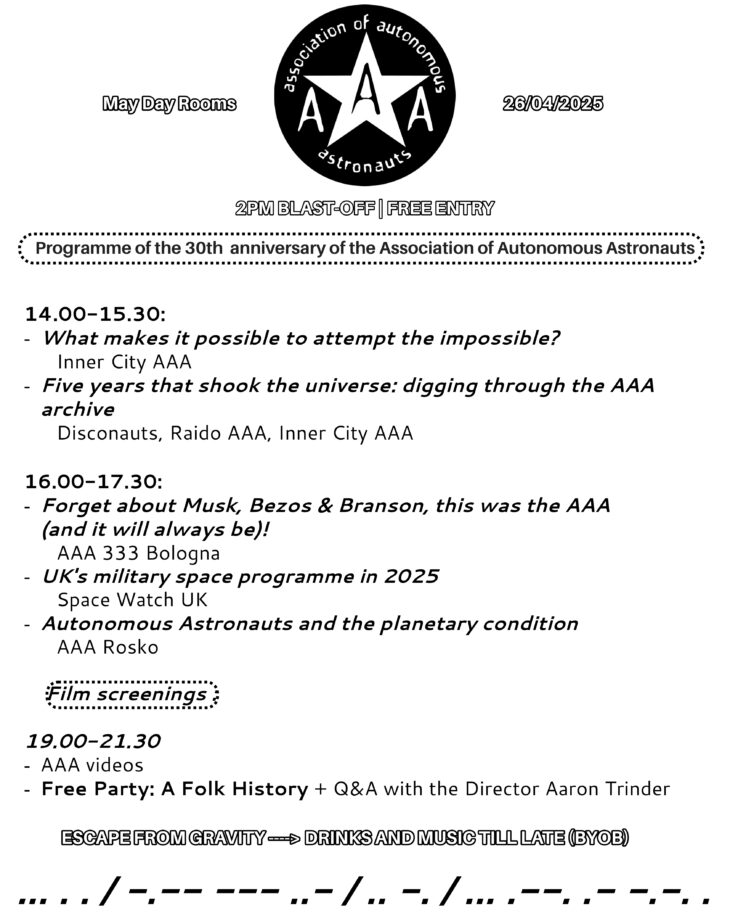
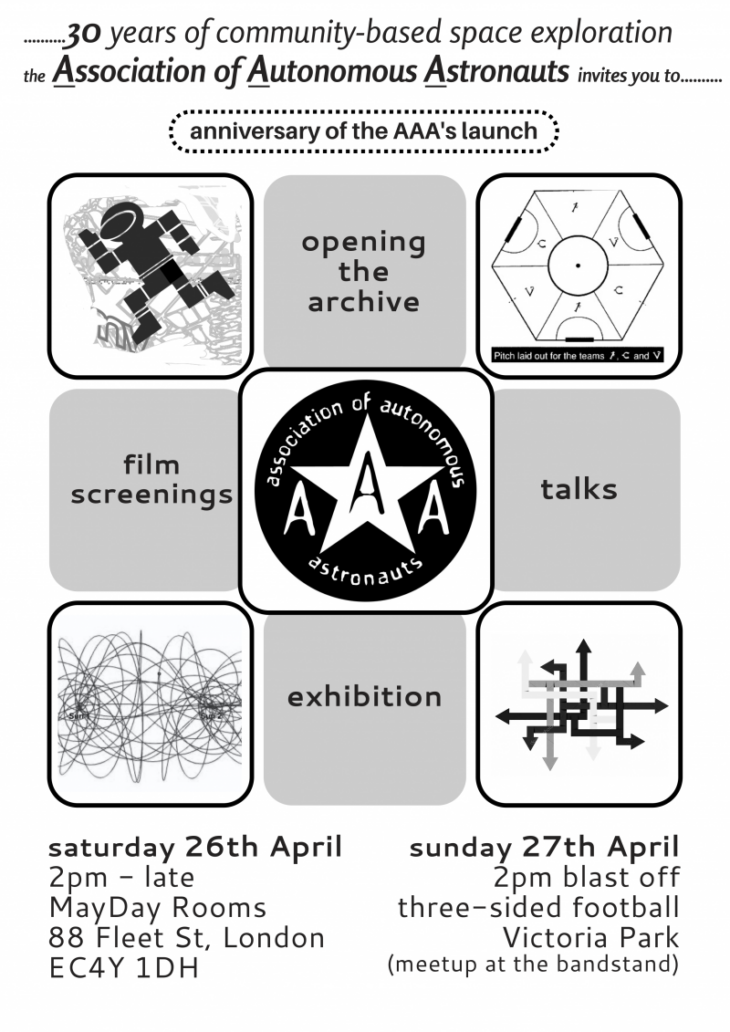
Saturday 26th April, 2pm* at MayDay Rooms, 88 Fleet Street, London EC4Y 1DH
It’s been three decades since the Association of Autonomous Astronauts (AAA) launched the first independent space exploration programme on the grounds of Windsor Castle. Between 1995 and 2000, AAA organized raves in space, played three-sided football tournaments, built spaceship launchpads in the heart of the city, took part in intergalactic conferences and experienced zero-gravity training flights—all while mounting a radical critique of government, military, and corporate control of space travel.
May Day Rooms holds a significant collection of materials related to the group’s activities, and that’s why we wanted to once again look up to the stars to celebrate the AAA’s 30th anniversary. We’ll explore how the Autonomous Astronauts’ original concerns resonate in today’s world—one shaped by billionaire space tourism, the increasing militarization of space, profit-driven interplanetary colonization, and a general sense of political imagination running on empty.
On the day, founding AAA members—alongside Autonomous Astronauts from France and Italy—will chart pathways into (and out of) the AAA, putting some of the group’s initial ideas to the test of time, while Space Watch UK will brief us on recent developments in the UK military space programme.
Expect an exhibition featuring materials from MDR’s Association of Autonomous Astronauts collection, screenings of AAA’s archival video materials alongside a rare showing of Aaron Trinder’s “Free Party: A Folk History” documentary, and, of course, a rave in space till late— with music, food and drinks! Prepare for liftoff!
*Start time is 2pm and not 3pm as it says on a previous version of flyer.
Sunday 27th April, 2pm Triolectic Football Tournament in Victoria Park, E9 (meeting at the bandstand)
On Sunday, we gather for the second day of the Association of Autonomous Astronauts’ anniversary—this time in Victoria Park for a three-sided football tournament! More than just a game, 3SF symbolizes the ongoing three-way struggle between government space agencies, private space corporations, and the AAA. But beyond its cosmic significance, it’s also an excellent training exercise for all aspiring autonomous astronauts. No previous experience is needed—teams will be formed on the day, and everyone is welcome to join in.
Between matches, we’ll take breaks for a picnic, so feel free to bring food and drinks to share. And yes, all animals are welcome—who knows, they might even get in on the action! Join us for a day of playful resistance, tactical absurdity, and autonomous space training. See you on the field!
This is a great new podcast/vidcast from DJ Controlled Weirdness aka Neil Keating. It covers 80s/90s London with a definite slant towards music and subcultures.
The first three episodes feature Ian Blackmass Plastics on the early days of rave, record shops, DJing etc. This was a great listen for me because Ian also grew up in Hertfordshire and so was frustratingly close enough to the action to know that something was going on – but distance, lack of knowledge and skintness meant that he missed out on a lot. The process of jumping in and making up for lost time is a joy to listen to though.
The latest episode features Howard Slater on postpunk in mid 80s Preston and late 80s London, with a nod to squatting and the free-improvisation scene. For me Howard has always been emblematic of a particular kind of working class guy who would seize on mad music and ideas without ever becoming pretentious or snobby about it. I remember some great conversations with him about books or artists I couldn’t get my head around and his enthusiasm for the subject – and the subjects that span off that subject was always infectious. I’m really excited at the prospect of him being on future episodes talking about techno, Dead by Dawn, his Break/Flow zine and more…
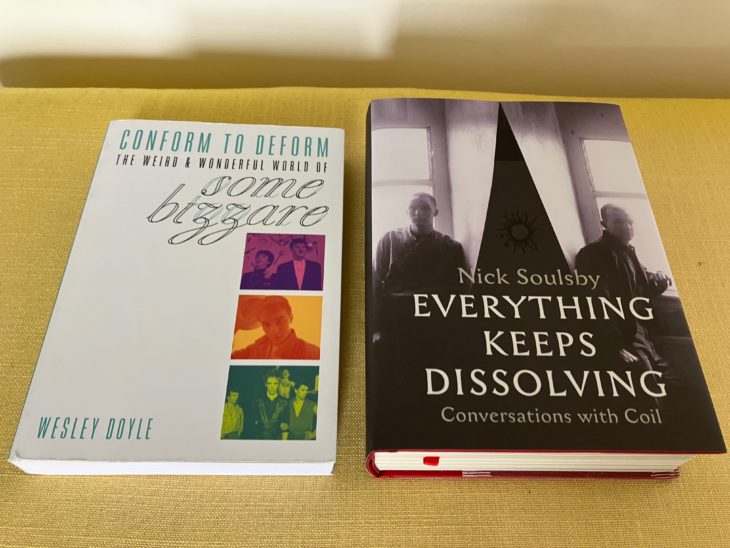
An interview Justin Mitchell and I did with Coil in 1991 appears in Nick Soulsby’s lavish Everything Keeps Dissolving: Conversations with Coil.
The cliche with interview collections or “XXXX in their own words” books is that they are a cynical cut and paste job to appeal to the fans. Nothing could be further from the truth here – Nick was very open to my suggestion that I write a new introduction to the interview I (half) did – and was very excited when I discovered the original tape.
I think it’s also fair to say that the art of the interview was something that Coil excelled at, so the book is generates a compelling narrative arc through the group’s obssessions, creative process and difficulties over time.
As is usual with Strange Attractor Press, it’s a luxurious affair that is a lovely thing to hold in your hand. I have a further short piece in another of their forthcoming titles too.
My holiday read this year was Wesley Doyle’s Conform to Deform: The Weird & Wonderful World of Some Bizzare.
As a teenager I was completely obsessed with Some Bizzare acts like Soft Cell, The The, Foetus, Psychic TV, Coil, and Neubauten. Still am. I was a bit sceptical about this book, but it’s actually a brilliant read – a tonne of interviews (new and old) strung together as an oral history. Stevo Pearce the autodidact svengali manager looms large, with many tales of his exploits securing major label deals for improbable people like Cabaret Voltaire, PTV and Test Dept. And his increasingly erratic behaviour and accounting processes. There are some fascinating insights into MDMA use before it became illegal too.
The really interesting material is the accounts by the women involved with the label who have never really had credit. Musician Anni Hogan gets an opportunity to set out her contribution to Marc Almond’s music post Soft Cell. Jane Rolink’s story is revealing and hilarious in equal measure – she is thanked in the sleevenotes of most of my favourite releases on the label and it turns out that she basically kept the show on the road whilst the various eccentrics spiralled out of control. Nobody has a bad word to say about either Anni or Jane. (The latter went onto to be handbag house superstar DJ Mrs Wood). Alaura O’Dell (formerly Paula P-Orridge) has some very incisive things to say about the label and the general atmosphere of early Psychic TV too.
As with many music books, this starts with heroic, creative young people and ends with slightly embittered drug casualties, but if you have an interest in the acts it is definitely recommended.
Upping the ante from podcasts, a few people I like are doing regular short video mags:
The Molehill Report is from the Praxis Records / Datacide magazine stable, with updates on their releases, footage of their artists and some great interviews about underground dance and experimental music culture. There are three episodes so far:
On a completely different tip, noisician and entropy-fancier GX Jupitter-Larsen (The Haters, etc) is producing A 5-Minute Hour – regular clips from a bunch of interesting people like GX himself, blackhumour, Irene Moon and Survival Research Laborotories. These can vary from spoken word to ambient and abstract, but are always a great watch. There are currently 14 episodes, so dive in:
Meanwhile, over on Instagram, Nigel Ayers of Nocturnal Emissions is doing a wonderful series of reflective pieces on his own work, life in Brixton in the 1980s and dub…
It’s Sunday morning and I am inhalingthis new oral histroy podcast from Kiss FM. You get eight 20 minute episodes and there is a lot of ground covered: from the cockney fast chat of Saxon Soundsystem right up to UK Drill.
There are some breathtaking moments, like Asher Senator describing his first few times on the mic for Saxon as well as some incredible recordings of MCs like Stevie Hyper D in full junglist flow. The drift and cross pollenation between genres is covered well – the Ragga Twins describe the evolution from dancehall to rave to jungle and there are some crucial insights into the Saxon MCs’ inspiring US hip hop artists too.
Friend of the blog Gabriel May makes an appearance talking about jungle artists working with dancehall MCs. Gabriel also recommended this next one to me:
The Bass Culture Research project is a product of the the Black Music Research Unit (BMRU) at my alma mater the University of Westminster. The unit’s Director is Mykaell Riley, formerly of Birmingham reggae legends Steel Pulse, so this is not some undergrad waffle.
Their podcast is surprisingly underexposed – it’s flipping great. Each episode is an in depth conversation with some towering figures in the history of UK reggae and bass culture. Lloydie Coxsone talks about being fitted up by the police in Brixton, Red Saunders features in two episodes about the formation of Rock Against Racism, Paul Gilroy is his usual insightful self on a whole range of topics.
I was especially taken with the episodes on people who are not usually interviewed. Dubplate Pearl gives us a much needed window into the life of a female reggae fan inthe 1970s onwards. There is an incredible section with her talking about her love for the hardest dubs rather than the lovers rock tunes that women are supposed to like. Wilfred Walker talks expansively about the struggles of being a black music promoter. And Janet Kay’s episode is a much needed look at the music industry from the perspective of a young woman too…
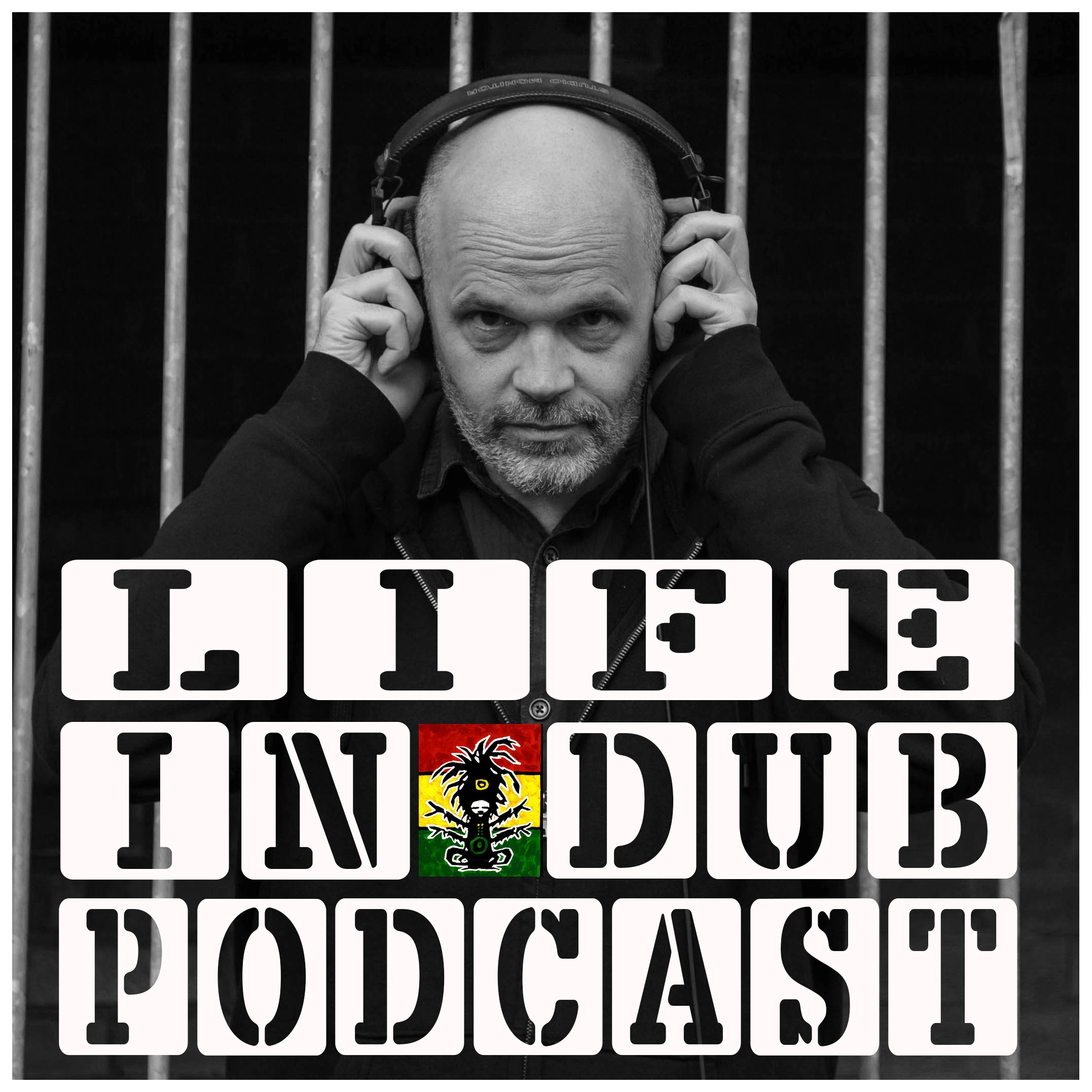
Life In Dub is presented by veteran UK Dub producer Steve Vibronics (who was also a great contributor to the much missed Blood & Fire forum). There are 35 episodes so far, focussing on UK Dub producers, label heads, musicians and vocalists.
Steve is a great interviewer that really connects with his subjects, who include legends like Scientist, Mark Iration, Abashanti, Russ Disciples, Dougie Conscious, Adrian Sherwood, Mad Professor, Dennis Bovell as well as newer artists. Many many great stories.
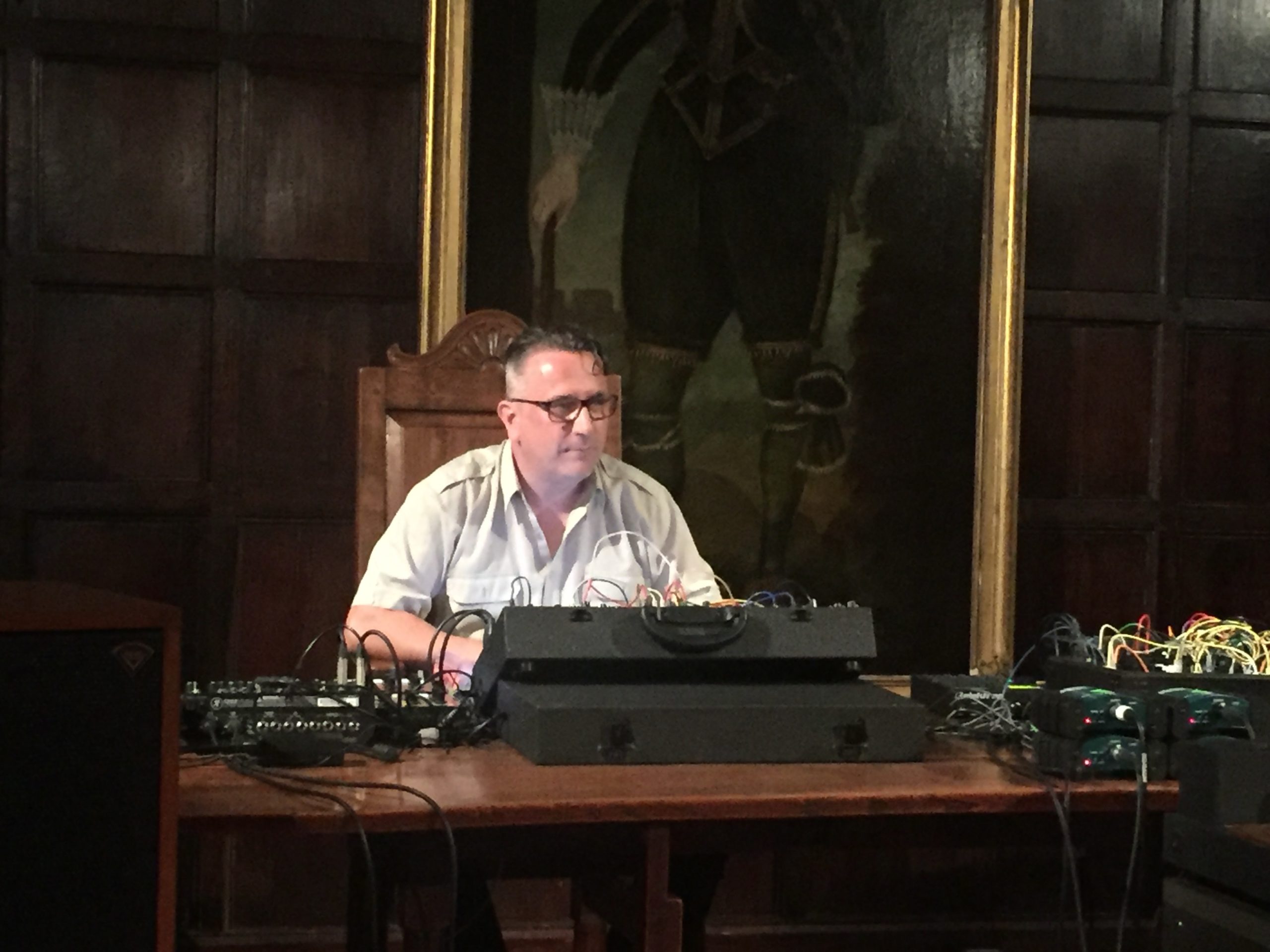
Peter Rehberg performing at Sutton House in Hackney, 2018. The last time we’d be together.
Peter cropped up in a few of my posts on here about the first 23 gigs I remember going to and even appeared in the comments boxes. He was a pivotal figure in my life – and in that of countless artists.
I was honoured to be asked by The Quietus to write a tribute to Peter and to contribute a short spoken word piece to the EMEGO 309 memorial event in Vienna that I was sadly unable to attend in person.
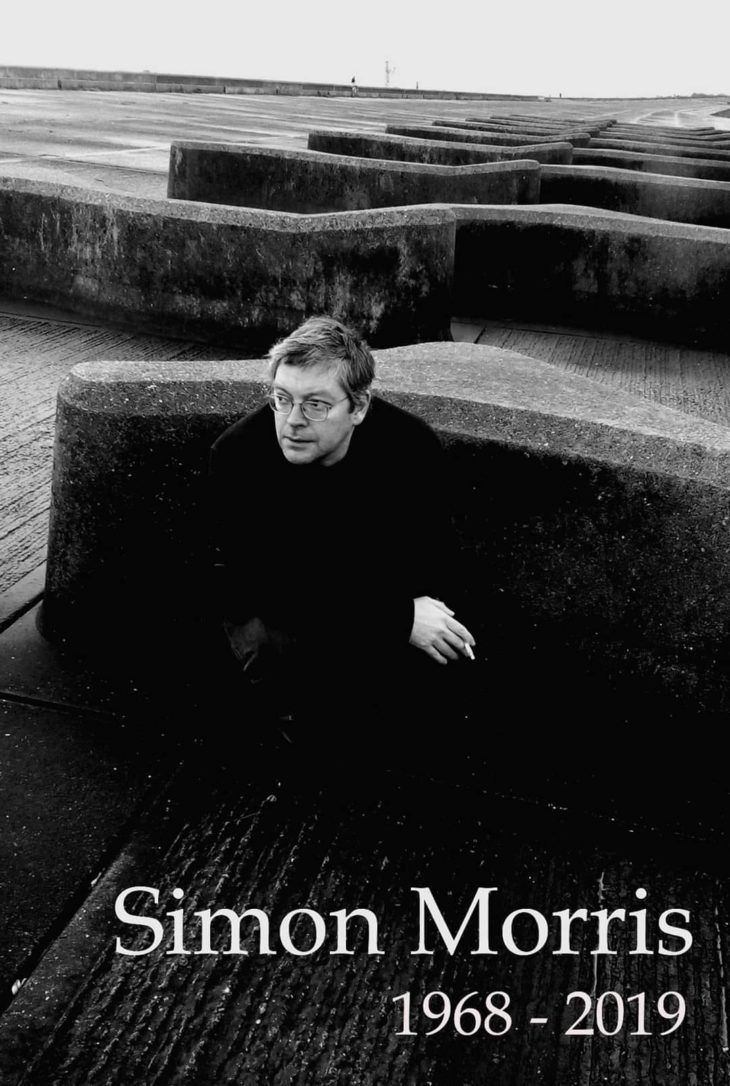
On the 23rd of November 2019 I ordered Sea of Love and Watching The Wheels by Simon Morris from Cargo Records.
It was a pre-order. I had absolutely loved his previous book from Amphetamine Sulphate Press, but I couldn’t justify the huge postage cost from America. So I’d been obsessively checking their UK distributor most weeks until the shipment came.
By the time the books reached me in early December, Simon had disappeared. He’d been due to fly to New York to perform with Lancastrian noise absurdists Smell & Quim. He never showed up.
I superstitiously left the jiffy bag on the side. I figured I would open it when Simon had been safely found. Time passed and a lot of us worried. Simon Morris and erratic behaviour were hardly strangers. As a veteran of the 1990s Mad Pride movement he’d worn his demons on his sleeve and bellowed about them across the astounding discography of Ceramic Hobs. A lot of people in that subculture burned twice as bright for half as long, and the first section of Simon’s debut book Consumer Guide is a compellingly raw account of friends and bandmates who died too early. He always seemed to bounce back though… didn’t he?
But by the 20th of December Simon was still missing and I was at home recovering from my office party. Images leaked slowly into my mind of my unprofessional conduct in the pub and the woozy journey home. Of pelting off the train one stop early to vomit voluminously on the platform, much to the disgust of my fellow passengers observing me out of the window. Then staggering the rest of the way on auto-pilot (I wasn’t going to get back on the train to sit with those wankers, no way).
Cringing with a headache, I figured that reading Simon’s latest material would take my mind off my utter wretchedness. So I opened the jiffy bag and got stuck in. It certainly helped, but when I paused from reading about an hour later, I read the tweet that a lot of people had been dreading.
Simon’s body had been found in the River Wyre near Thornton in the North West of England, not far from where he lived in Poulton-Le-Fylde. He was 51.
This hit me pretty hard and not just because of the hangover. Simon wasn’t famous, but he meant huge amounts to hundreds of people. His music was wilfully underground and deranged. His writing unnervingly honest. In person you never knew what you were going to get, but every time I bumped into him, my day was always the better for it.
He’d been drinking “all the way down the motorway” before the Sleaford Mods / Consumer Electronics show at the 100 Club. Still charming, but also going off on rants about the Who Makes The Nazis website and ensuing spats. We were outside for a breather. I remember him slowly drifting backwards off the pavement – almost into the traffic on Oxford Street before I gently tipped him back onto his centre of gravity. Neither of us remarked on this and the conversation continued to flow.
We fell out over the important things, I suppose. Fascism, personal freedom, the big ticket stuff. Simon’s total commitment to freedom of speech and artistic expression was obviously problematic and a complete pain the fucking arse. He would, at times, excuse any old shit. I loved him though and my inner puritan needs calling out occasionally.
Simon emailed me once in the middle of his holiday and demanded that I interview him because he was proper pissed off by what he saw as the creeping censorship and moralising from anti-fascists. I think he thought that he was throwing down the gauntlet, but my first reaction was that this sounded like an amazing idea and I that would love to read something like that. So we did it for my fanzine Turbulent Times along with a Ceramic Hobs feature.
Last year Simon was off on one about The Quietus’ piece on the increasingly dodgy Skullflower. Our emails reached a peak of vitriol and then receded into good-natured taking the piss out of each other. Shortly after this he sent me a draft of a foreword he had written for some art book about Skullflower. It included a good number of sentences by me, slagging them off, from our email chain. He wanted to know if that was OK and it absolutely was – I was delighted. The publishers of the book were less charmed and deigned not to include Simon’s piece, as they “didn’t want to drag ‘real world’ considerations into our sovereign realm of the senses” – which is hilariously pretentious cowardice for an operation so keen on transgression. It fucks me off that I can’t have a laugh about that with him.
The first time I met Simon was in the White Hart in Stoke Newington. I was at a mate’s birthday celebration and he was, oddly, at a different guy’s birthday celebration in the same pub. We’d been emailing each other since the year 2000 I think when he had sent me a CD of Ceramic Hobs’ outstandingly odd “Psychiatric Underground”. Ceramic Hobs were one of the select few “mp3 of the month” features I did at that time. We got on well. I told him how much I’d enjoyed his Bang Out of Order zine and how it had changed my mind slightly about power electronics.
The last time I saw Simon in the flesh was at a Mad Pride matinee at the Lexington in Islington. It was a beautiful Spring day in 2015 and Ceramic Hobs had played a blinder. It was the first and last time I would see them live. The sun shone outside and I spoke to both Simon and Rob Dellar who was one of the organisers of the event. (I’d known Rob even longer and he died about a year later and I failed to write about him when that happened.) Rob’s book Splitting In Two is the best account of Mad Pride in the UK yet and Ceramic Hob’s back catalogue is – in my, relatively sane, opinion – as good a soundtrack to that movement as you will get.
Simon’s on-page and on-stage persona belied his gentle humour and generosity. Now there’s Nothing Here Now But The Recordings, you can see increased interest in his backcatalogue. Which I guess is inevitable but ghouish – and on balance probably a good thing. But of course it isn’t the whole picture. A lot of people knew Simon better than I did, but for me this interview with Ceramic Hobs is a decent enough tribute:
We parted on good terms, thankfully. Over the last year there’s been several things that I desperately wanted to tell him about. It pisses me off that I’ll never get the chance to do that.
Apparently I went to 26 gigs in 2019, but have only managed nine this year, for obvious reasons. That’s not bad going.
Like everyone, I’ve found 2020 quite tough and have struggled through as best as I have been able to.
And like many of the people reading this (hello! I miss you!) I’ve gritted my teeth quite a lot, understanding that the challenges I’ve faced have been pretty mundane compared to those on the frontlines of either vulnerabilty or essential work.
I learned many years ago to cherish my nights out to see music. To make it my mission to squeeze as much enjoyment, intrigue and fun interactions with friends out of them as possible. Because things change – bands split up (or turn shit), venues shut down, genres mutate.
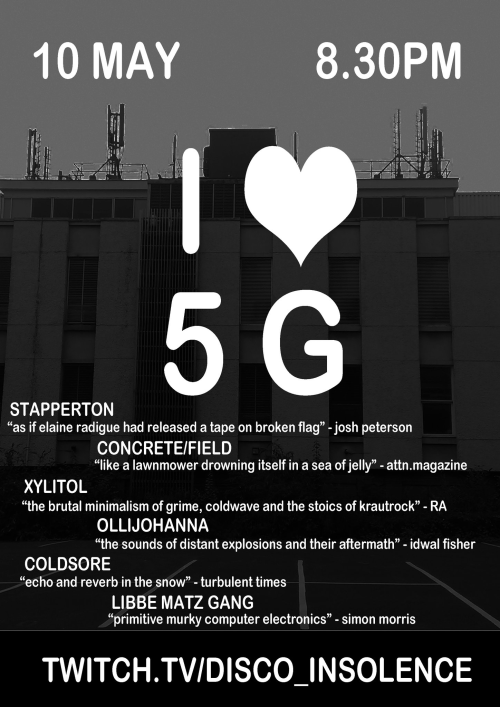
During the lockdown a bunch of us experimented with net-based music events. Tusk’s online festival and the occasional stream from Cafe OTO kept me relatively sane. I spent the eve of my birthday watching some incredible online A/V sets from Spatial, EVOL, Tim Reaper and others courtesy of the comrades at the Broken20 label and their Further_In platform. And I must give a special shout out to Disco Insolence et al for their bold-but-doomed “I Heart 5G” evening back in May:
The shine wore off after a while though:
Same thing day after day – eat – latop – eat – laptop – eat – laptop/TV – sleep – eat – laptop – how much more can you take? – one in ten go mad, one in five cracks up.
I missed people, crowds, friends, randoms. Different people in different rooms, making different noises you could see, feel and almost touch.
I don’t usually write about gigs. This is partly because I find it hard to express my experiences at them. And partly because knowing I will write about a gig means that I experience it in more constrained way. When I make mental notes, I miss what is happening in front of me – it’s less immersive, which is the whole point. Also I am quite lazy and the days of me fantasising about becoming a music journalist are long gone.
But screw it. I thought I’d give it a go now. Why not? None of us have other plans, eh? So this is an indulgent way of showing off about things I have managed to get to this year – to give credit where credit is due, and hopefully to invoke more gigs for 2021.
Here we go, in reverse order of awesome rather than chronology:
(All photos by me.)
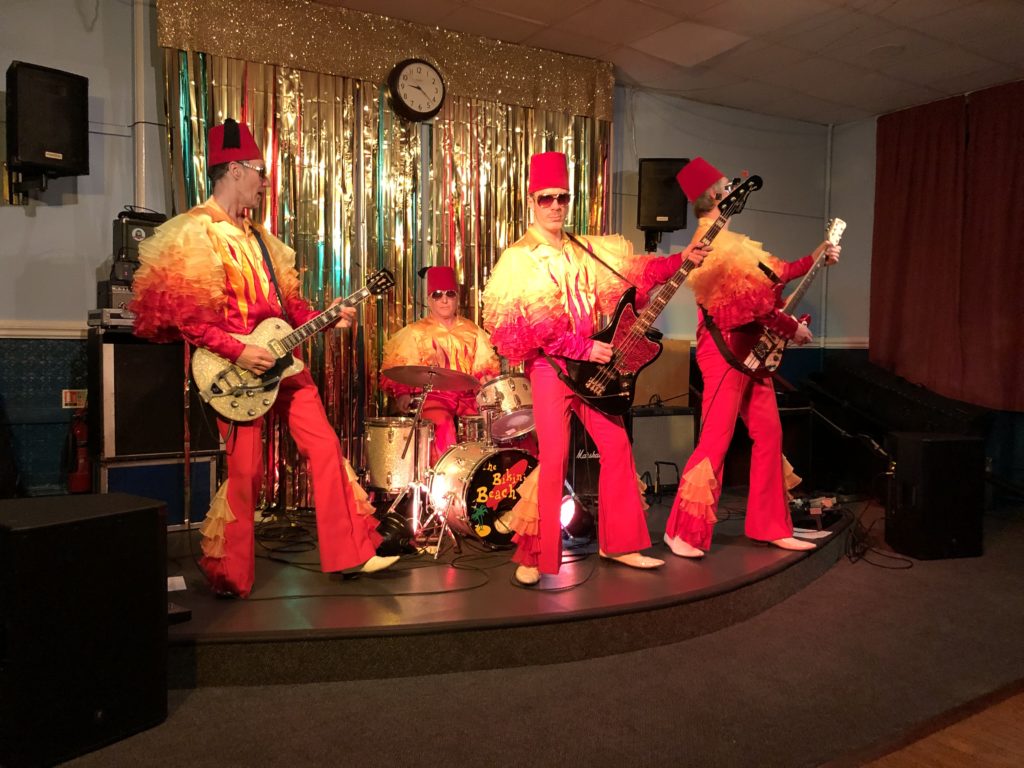
9. The Bikini Beach Band (Mildmay Club, 29 February 2020)
Bikini Beach Band
I think by this point of the year we were jokingly bumping elbows with each other when we met.
The BBB are Stoke Newington stalwarts who I first saw way back in the 1990s at various free festivals in the area. Support your local surf rock band! Their sets combine genre-standards with blazing covers of oldies and goldies – everything from Britney’s “Toxic” to a Kraftwerk medley.
The Mildmay opened as the Mildmay Radical Club in 1888 and is now an uneasy alliance of traditional working mens’ club types and newer hipper people. The building has vibes galore and is often used for film shoots and music vids. I love it.
This was one of those nights where you’re getting warmed up with a few drinks and enjoying some great music when various factions of friends overlap. And before you know it there is a gang of you getting absolutely trashed at the Mascara Bar til the early hours with loads of beautiful LGBTQ+ people while the DJ plays hi-nrg and other top selections. Sunday was a write-off.
8. Dave Tucker, Thurston Moore, Mark Sanders and Pat Thomas(Cafe OTO, 4 March 2020)
I was talking to Steve Goodman once at Plastic People and he told me that it had become his second living room. I liked the ambiguity of that – the comfort of a deep relationship with a small venue is a beautiful thing. At the same time it does suggest a comfort zone and potentially a bit of complacency and lack of adventure. But, for better or worse, Cafe OTO has become my second living room over the last 12 years.
The first time I went there was to do a DJ set between bands on Thorsten Sideboard’s peerless label Highpoint Lowlife. The music was great, the place was kinda warehousey, the people were nice, a bunch of my mates swung by, it was a good night. I kept going back. Paul STN dragged me to see deranged saxophone walrus Peter Brotzmann. I went on my own to see Northern free-improvisers The A-Band, who had more members than audience.
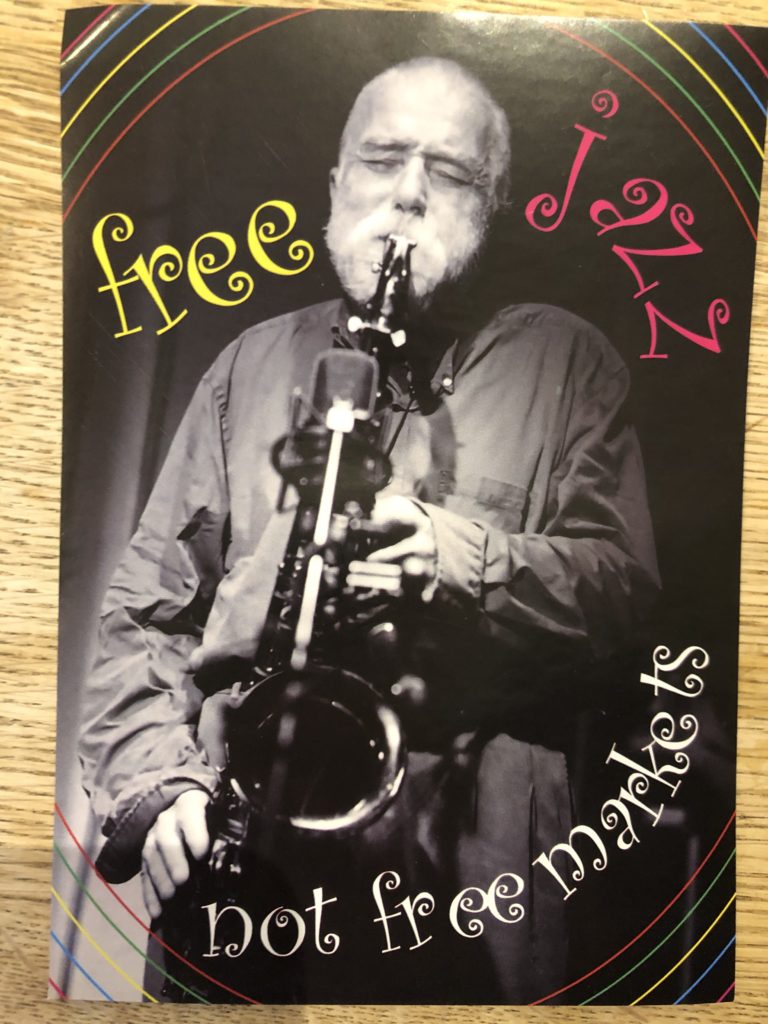
Peter Brotzmann on a sticker found at Housmans Bookshop
The music at Cafe OTO was like drugs in this honeymoon phase. About 15 minutes in, I’d think to myself “oh no, maybe this will be shit, what I am doing here?”. But then… lift off! It turns out that Sun Ra was right – there ARE other worlds they have not told you of. My ears and brain were rewired and upgraded.
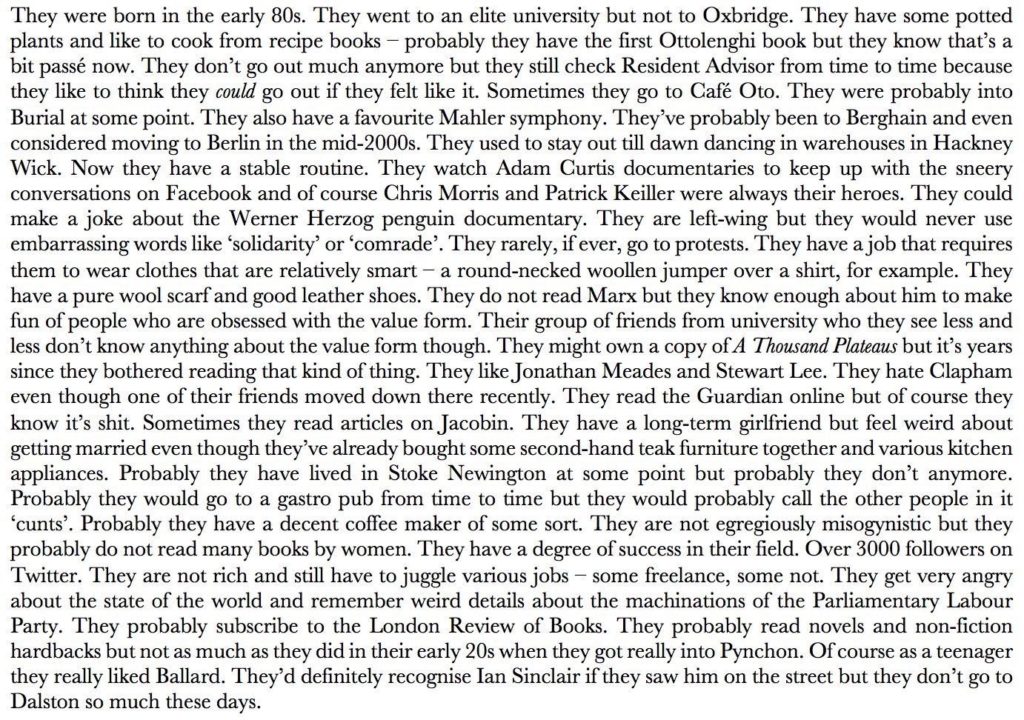
A small group of us head down to Cafe OTO a few times a month. We have seen things you wouldn’t believe. Incredible music and occasionally awful music which stimulates our folklore of very funny anecdotes. We know we are cliches. A woman on twitter (whose identity eludes me) exquisitely skewered an “OTO type” a few years back:
But we are older than them and we have less to prove. We have spoken to people even older than us in between sets and they have told us their war stories from the 1970s with a twinkle in their eye. We’ve struck up conversations with young people who seem a bit intense and they are lovely and have travelled for hours to see something by an artist who means a great deal to them. And there are more women and BAME people at Cafe OTO than there ever were at some of the gigs I went to in the eighties, not that this would be difficult.
Three years ago I organised a showing of GX Jupitter-Laren’s cult film “Omniwave Refresher” at Cafe OTO and everyone I dealt with was brilliant at their job and super understanding about the niche nature of the event.
I can’t remember much about this gig. In early March it was probably just another great night out. I do recall being in front of someone in the queue who was coughing. Dave Tucker was in The Fall circa “Slates”, Pat Thomas is an incredible pianist and force of nature, Mark Sanders does unbelievable things with drums. And Thurston Moore was less irritating than usual.
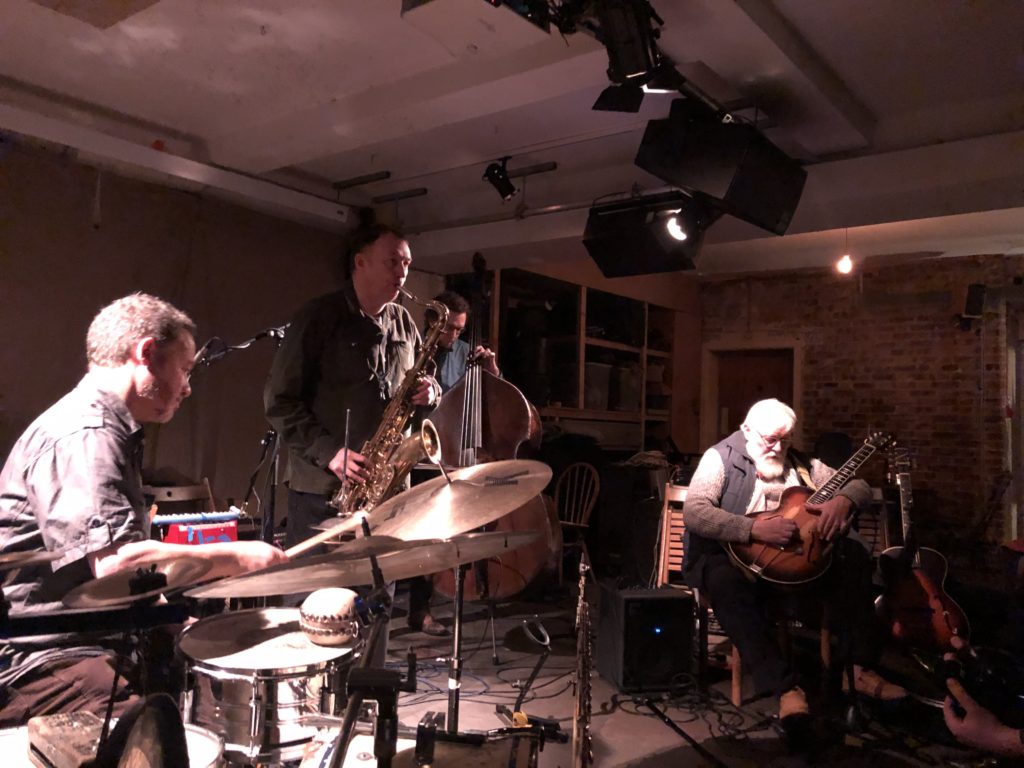
7. John Butcher, Dominic Lash, John Russell and Mark Sanders / Consorts (Cafe OTO, 13 January 2020)
Sanders, Butcher, Lash, RussellConsorts
The first gig of the year is always special – catching up with mates, re-immersing yourself in the sound. This was, we agreed, the one to kick off with. Double Bassist Dominic Lash’s birthday bash. The first set was the high-wire improv quartet workout which is Cafe OTO’s stock in trade. I know a lot of people are sceptical about that sort of thing. I used to be sceptical. But if you’re into music there are few things more pleasurable than seeing some incredible characters spontaneously producing some of the most amazing music you have ever heard. You don’t know what is coming next – hell, the artists don’t know what is coming next. And usually you will never hear it ever again.
Seth Cooke’s contraption
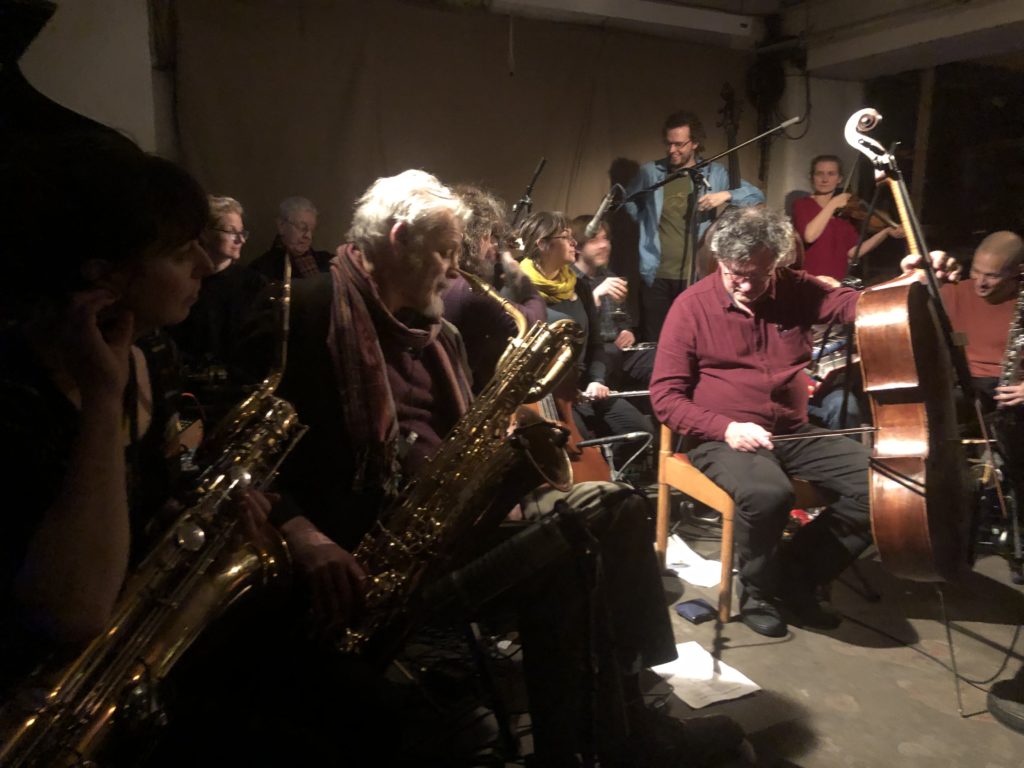
The quartet was followed by a ridiculously huge ensemble affair: “Consorts”, who on this occasion included a stellar cast of maybe twenty people. We sat up front and quizzed percussionist Seth Cooke about his mad scientist gadgets. Steve Beresford lurked around at the back. I can’t remember how the sounds were organised, maybe Lash conducted them? It was a wild joyful ride anyway.
6. Alexander Hawkins (Cafe OTO, 1 November 2020)
This was almost certainly my last gig of the year, immediately before London went into Tier 2 and Cafe OTO closed for the second time in 2020. I made every effort to be amongst the 30 or so people who were admitted that night. Friends who didn’t make it are now filled with regret – their reservations about a night of solo piano now outweighed by having missed out.
For me this was all quite poignant and emotional both in terms of the music and my feelings for the Cafe OTO staff who have had a desperate year trying to keep the show on the road. For one last night OTO was almost back to its brilliant self. Alexander Hawkins played great and did some heartfelt spoken intros. My batteries recharged.
5. Jean-Marc Foussat, Evan Parker and Daunik Lazro (Cafe OTO, 22 January 2020)
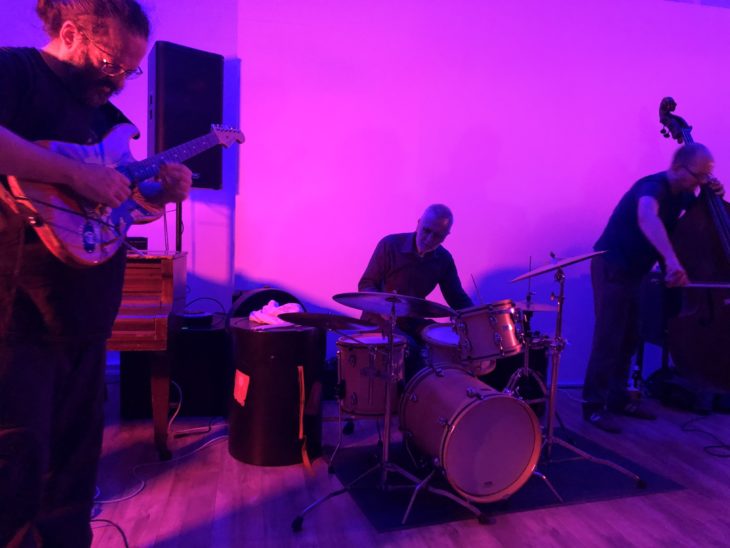
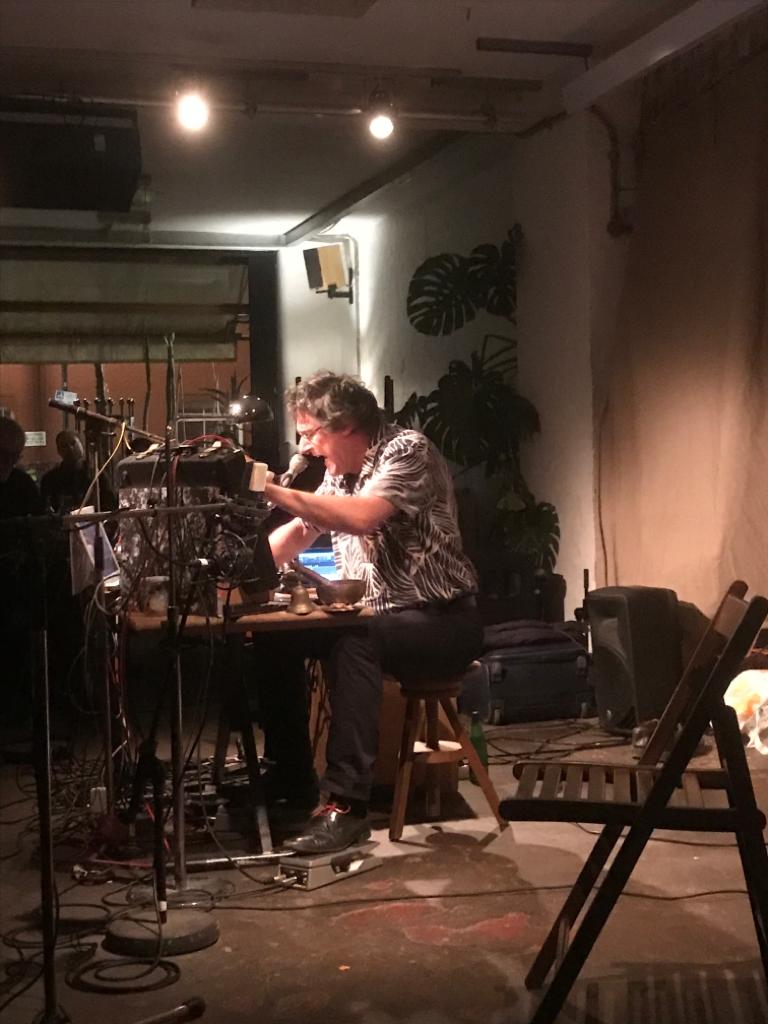
Jean Marc-Foussat
Jean Marc-Foussat is a 65 year old French-Algerian dude with a background in avant-rock, but is mainly known for his electro-acoustic / musique concrete works. (He has a Creel Pone bootleg, spotters).
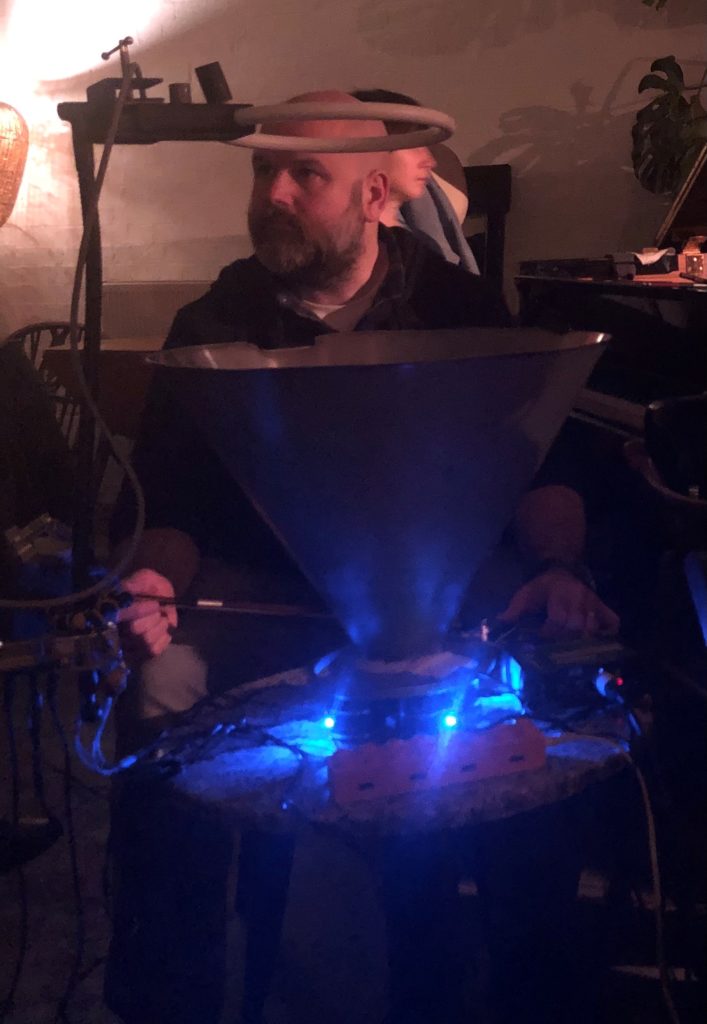
Jean-Marc did a deranged solo set of radiophonic pulses with his own non-verbal vocalisations and ululations pon top. It was bonkers and we were in awe, riding the peaks and troughs of this weird guy’s soundscape while watching his facial contortions.
For the second set he was joined by saxophonists Evan Parker (on tiny tenor) and Daunik Lazro (on big baritone) who are both in their mid 70s. But if you think that this meant a sedate meander, well then I am sorry for you, my friend.
Parker and Lazro fed off each other, producing long drones with sharp edges, while Foussat gently vocalised and sprinkled the odd bit of electronics. Then matters became intensely noisy all round, like a drunken marching band. And it just got more mental after that – piercing tones, wild electronics. A burst of static signalled an abrupt end. Apparently because Foussat’s equipment had broken.
The trio bravely reassembled for an encore which initially featured more of Fousatt’s odd vocals and less electronics. But then everything was briefly notched up to 11 once again and became indescribable. Bang. Finish. Rapturous applause.
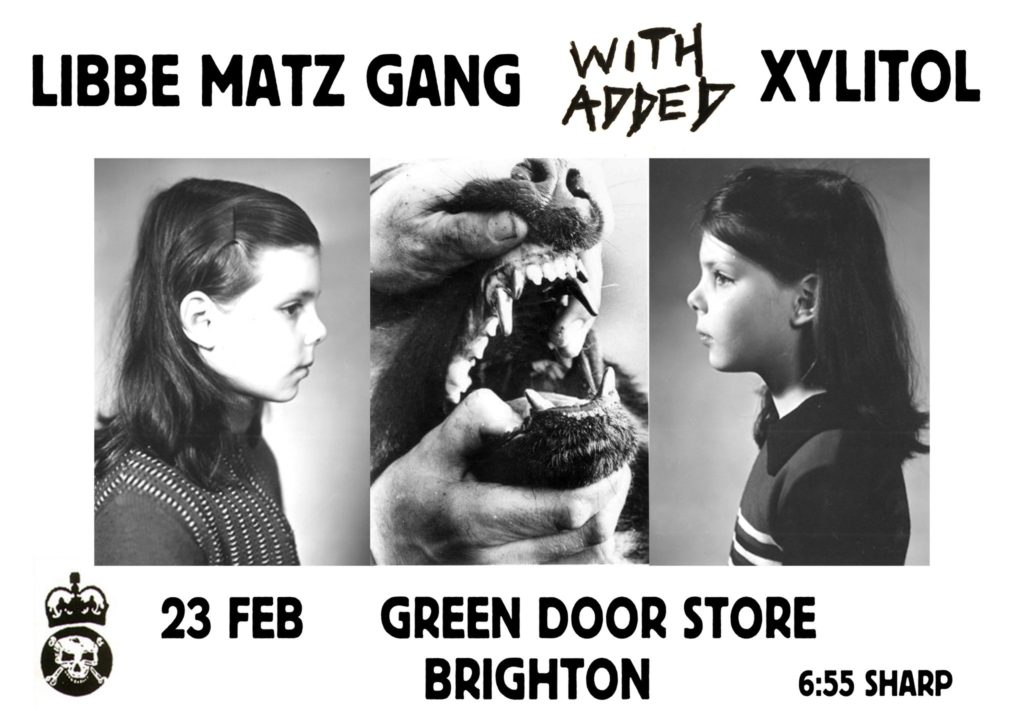
4. Libbe Matz Gang and Xylitol (Green Door Store, Brighton, 23 February 2020)
My connections with this lot go back many years. I’ve known Catherine Backhouse since the nineties and have eagerly snapped up every release of her Xylitol project. Her Slav To The Rhythm show on Neon Hospice with DJ Sarma is an essential listen if you want whacked out disco, synthpop and electro from Eastern Europe (and who doesn’t?).
Our connection is best summed up by what happened in June 2014. I’d been doing a few mixes themed around Suicide’s “Dream Baby Dream” track at the time. Anyway, I was on my way home from work and had reached Liverpool Street Station. A woman clad entirely in black stood in my way. I guess she was in her thirties and had that sorta squatter / techno / anarchist schtick going on. There may have been piercings and sew on patches, you know the deal.
“Are you John Eden?” she asked, with a German accent. I confirmed that I was and struggled to think if we’d met before. She looked me up and down and I got the distinct impression that she was assessing whether or not I was bullshitting her. (As far as I know people generally don’t pretend to be me, but whatever?).
She held my gaze and handed me a package. “This is for you. Don’t follow me.” I watched her walk away, half shocked and half bemused. She joined two similarly dressed blokes by Costa Coffee and they strode out of the station together without a look back.
I stood on the concourse of Liverpool Street Station in my work suit and looked down at the package I was holding. It was a thin square cardboard envelope with no markings. Obviously I opened it.
Inside the envelope was an acetate record. By Libbe Matz Gang. A cover of Suicide’s “Dream Baby Dream”. In an edition of one. Hand delivered to me. On my 45th birthday. Woah.
Xylitol and Libbe Matz Gang had previously worked together on the towering behemoth which is the “Ghost Office / Solvent Halo” split seven inch, but Catherine has given little away about LMG over the years despite my inept attempts at interrogation and begging.
There was no way I was gonna miss their first gig together.
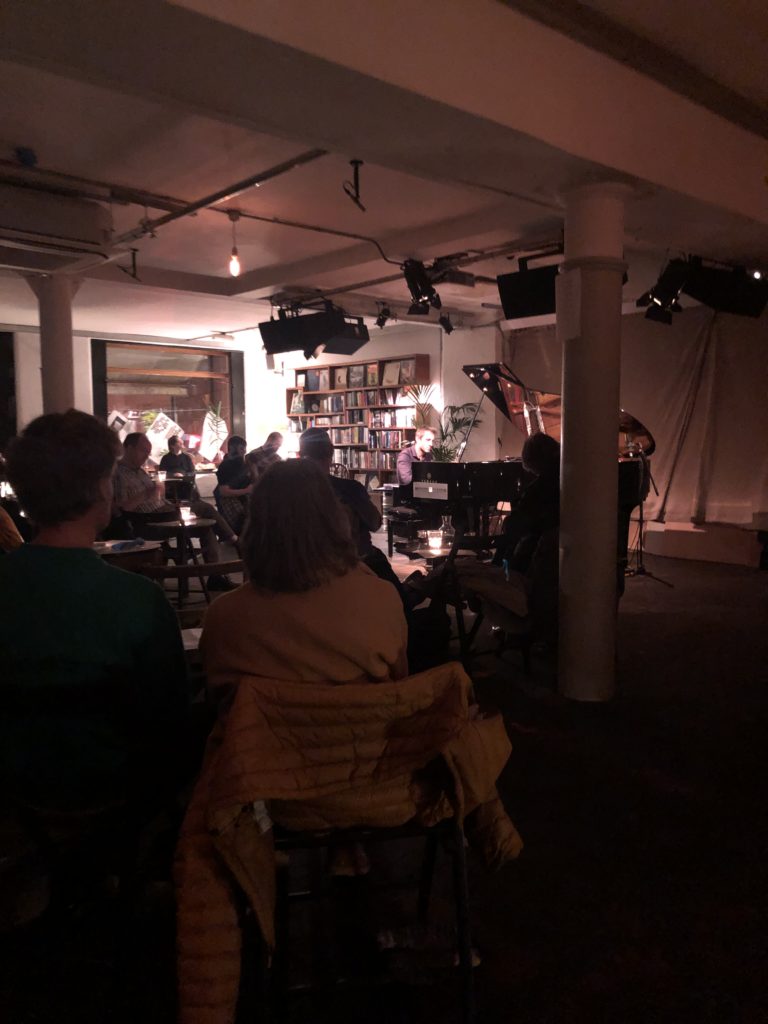
Green Door Store is a down-at-heel space beneath Brighton railway station. It turned out they were running an all-dayer for local acts, which I guess Xylitol qualify as (though I’d say they are too Kosmik and Outernational for that). I wasn’t bothered about the other groups especially, but there was a nice feeling of people working towards sustaining a local community of musicians. I was curious about how Xylitol’s finely honed electronische tunes would work with LMG’s anarcho-scuzz-noise, but as usual Catherine diplomatically deflected my nerd questions.
I scanned the crowd to see if I could spot any of my birthday stalkers, but it was too dark.
Catherine and an unknown male took to the stage, presciently wearing medical masks – something we would all be doing a month later. The set was accompanied by projections of… monkeys. Essentially monkeys in captivity, including some eerie documentary footage of American (?) women who keep monkeys as pets and dress them up. This was very effective and conjured up anarcho-punk fanzines and record sleeves of yesteryear, as well as making comment on the general state of power relations in 2020.
It was clear that Libbe Matz Gang were in the driving seat for the visuals and this was also the case for the sonics. The film was soundtracked by a shifting atmospheric noisescape which was the business. They didn’t play the hits – it was all new material as far as I could tell. I was not disappointed.
Halfway through the set I sensed someone staring at me from about twenty feet away. I looked around and spotted the woman from Liverpool Street Station. I smiled and made to move towards her, but she put her finger to her lips as if to say “Shhh!” and pointed back at the stage. She had a point, the performance was intensifying and I lost myself in the wall of sound and terrifying monkey imagery. Everything reached a crescendo and then stopped. There was applause and a rush for the bar. After which the Libbe Matz Gang entourage had vanished into thin air, even their guy on stage as far as I could tell…
3. Valentina Magaletti and Susumu Mukai (Cafe OTO, 25 October 2020)
Valentina Magaletti
I had no idea about either of these lot, but was so desperate for a gig that the novelty of being amongst friends and hearing live music – any music, forced any concerns aside.
I needn’t have worried, it was great. Valentina started with a solo set of drums, percussion and effects. Wearing a mask, with a socially distanced audience that I felt luck to be part of. She’s really REALLY good and to my ears has been influenced by the all-inclusive spirit of post-punk (rather than the cliche of slightly angular rhythms). So, for example there is a healthy slab of dub in there, but it’s dub as technique, NOT as a limp tribute to reggae.
Her digital EP “A Queer Anthology of Drums” on Cafe OTO’s Takuroku label is recommended. (The label is a showcase for artists who have recorded during the lockdown). She’s played for dark techno dudes Raime, spotters.
Valentina was joined by Susumu Mukai on bass for the second set. Susumu records as Zongamin and his Takuroku release “Street Surgery 4” is also highly recommended.
Together they produced an evolving landscape of interlocking dark grooves that had my head proper nodding. You could tell at the end that it had been exactly what everyone needed. We all stayed late and drank too much.
2. Eddie Prévost, Henry Kaiser, Olie Brice, and N.O.Moore (IKLECTIK, 11 March 2020)
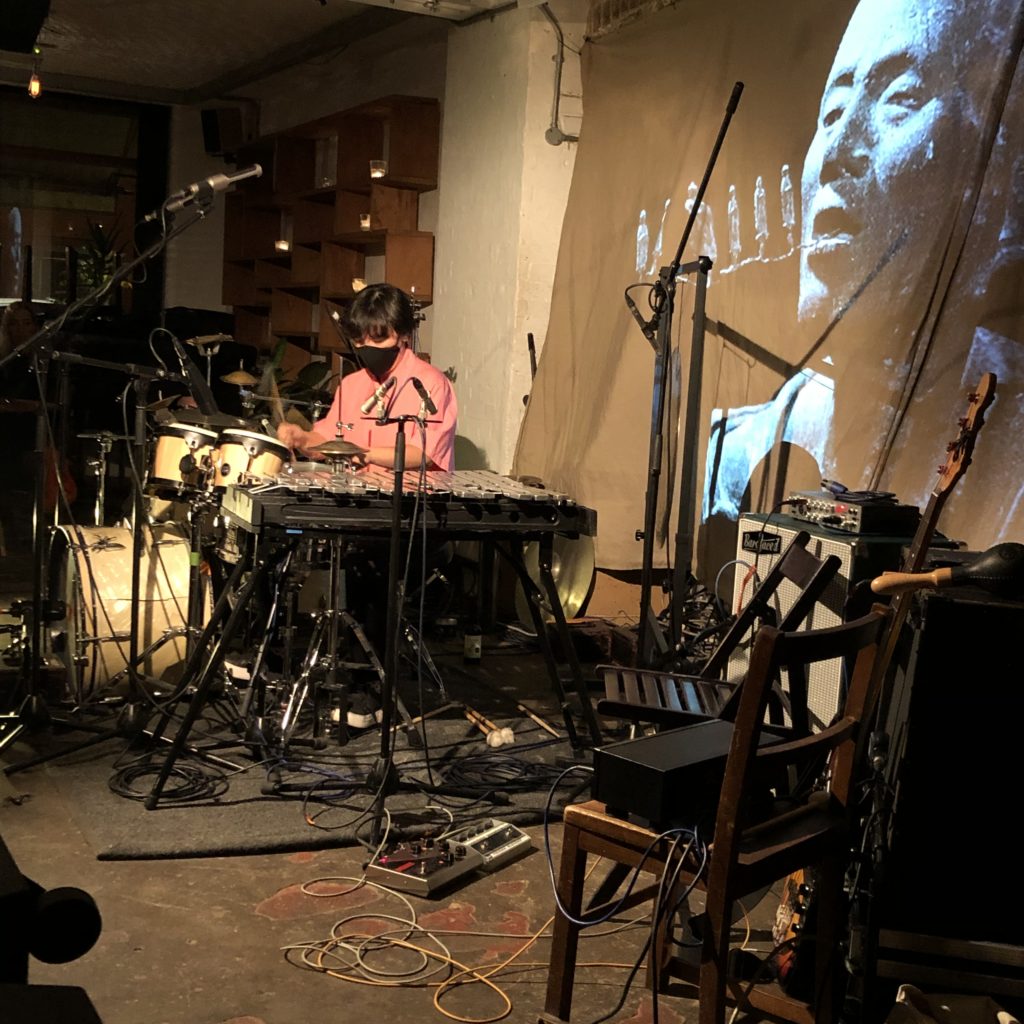
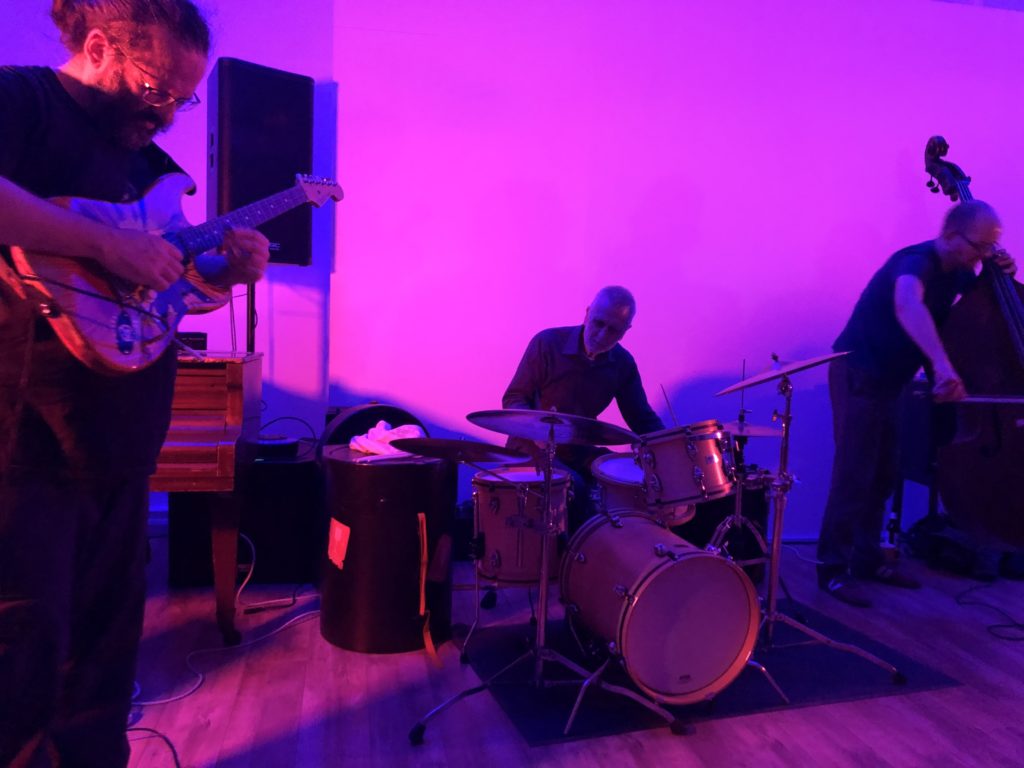
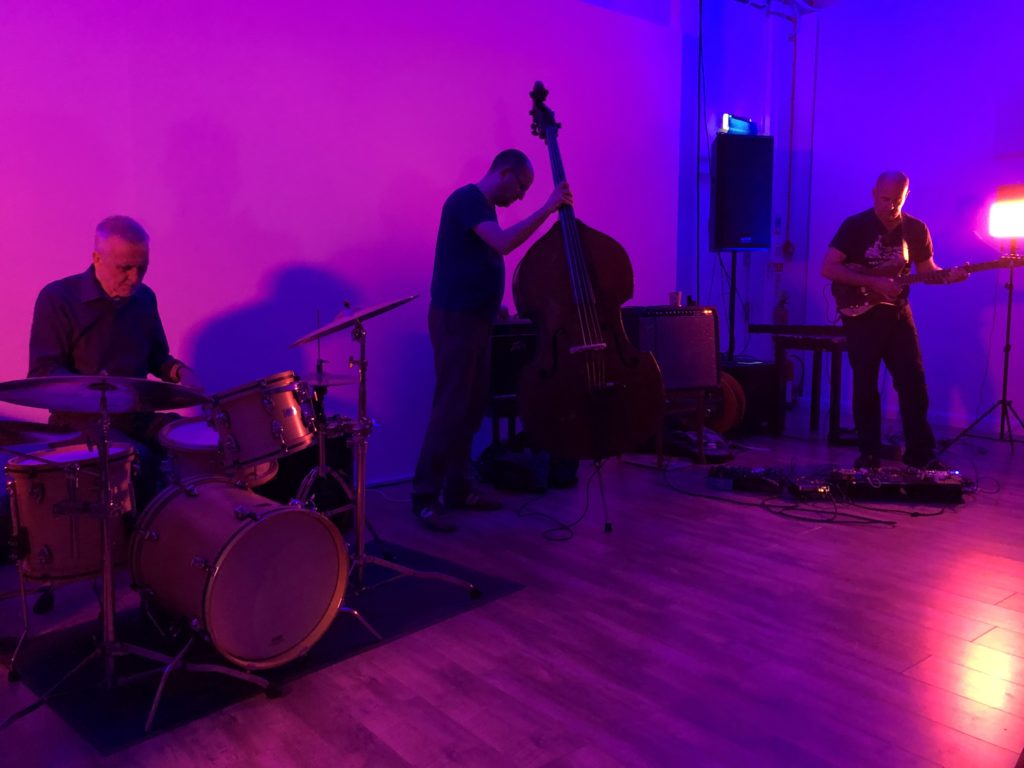
Moore, Prévost, BricePrévost, Brice, Kaiser
IKLECTIK is one of several big shacks on some reclaimed land in the railway interzone of Waterloo. I can walk there from work, but rarely go – which is pretty stupid on reflection.
Eddie Prévost is a stalwart of London free improvisation, having been a member of AMM alongside Cornelius Cardew. Prévost is an incredible drummer and “Flayed / Crux”, his collaboration LP with Organum is a cornerstone of what is erroneously called “zen industrial” / drone / improv. (And Steven Stapleton plays a metal chair on it too, spotters).
By March 11th everyone was getting a bit angsty. The first few COVID-19 deaths in the UK had happened. Prévost is pushing 80 and partially sighted. I was worried about him. To be honest, I wasn’t sure if I should be out and didn’t want to be infecting anyone, let alone septugenarian improv legends.
Henry Kaiser is an American guitar improv legend who has recorded with John Zorn and had a few LPs out on SST Records when they got all that hardcore punk stuff out of their system and went weird.
They were joined by Olie Brice on double bass and N.O. Moore, also on guitar. I have learned to be wary of electric guitar players at improv shows. There is a tendency for rock dudes to join the scene and bring their awful chops with them, drowning out the other musicians.
But this was not that. It was beautiful, intricate, intimate, inspiring. Worth the risk for me. Eddie had needed help to get to his drum kit, but was in his element playing. We spoke to him briefly afterwards and he seemed delighted that we’d enjoyed it so much.
Nine days after this gig, all UK venues would close until October.
1. Moor Mother, Galya Bisengalieva, Ono, and Elaine Mitchener (Cafe OTO, 15 February 2020)
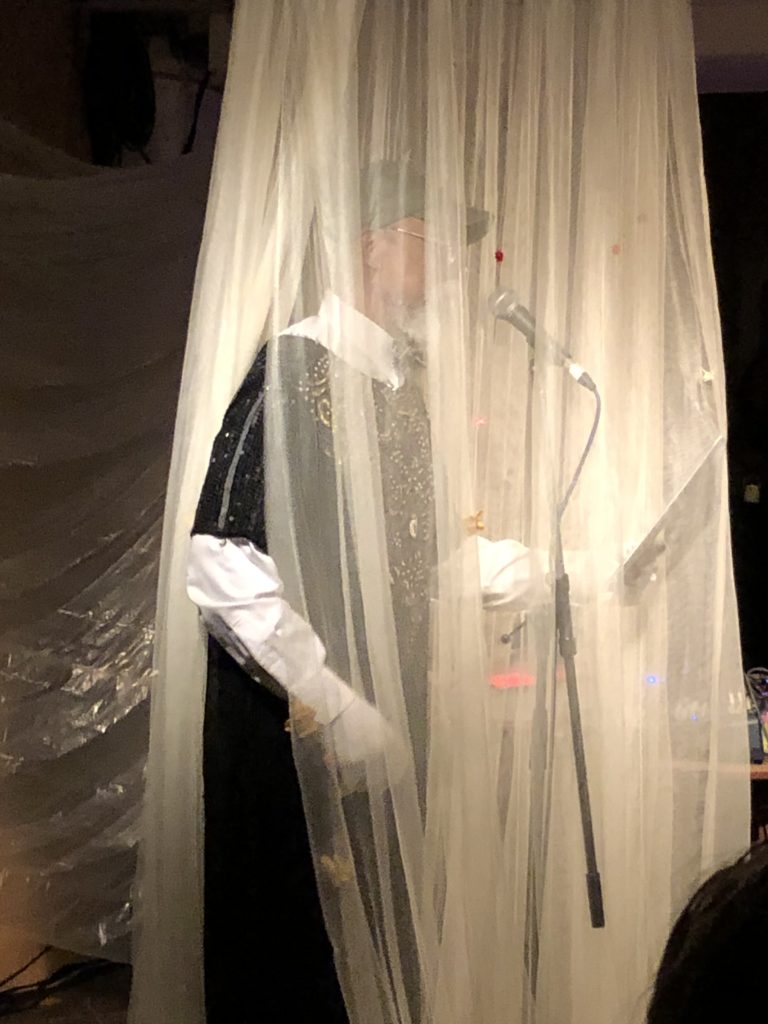
ONO: travisONO: P Michael Grego
This was part of a three day Cafe OTO residency by Moor Mother, who I knew little about except what I had read in The Wire and that she had worked with Kevin Martin.
Sometimes I wonder if my visits to Cafe OTO are just a bit of harmless escapism, that the politics of experimental music are overstated and indulgent. And so very very white and middle class. Then something comes along and smacks me in my stupid face.
Once again my memory is not 100% on what happened, but I can tell you that Cafe OTO was rammed out and that the subtext for the evening was black history (perhaps overshadowed by Black Lives Matter). But this was no leaden sloganeering political “cultural rally”. It was cutting edge black art for a multi-ethnic London audience.
Moor Mother kicked off with spoken word alongside violinist Galya Bisengalieva. Which eludes me now, but was great. And I’ve seen enough dreadful spoken word to be
Elaine Mitchener was up next. She is firmly in the mould of artists who do things at Cafe OTO which are impossible to describe without sounding utterly ridiculous and yet, in the flesh, are incredibly affecting and powerful.
I first saw Mitchener in December last year. At that gig she had combined searing gospel lyrics, guttural non-verbal vocalisations and… a squeaky pig toy. It sounds absurd, but it was so powerful that I found a young man crying in the toilets after her set because had been so overwhelmed by it all. (We had a brief chat and he was OK.)
Elaine did not disappoint at this gig either. I would advise everyone to check out this lockdown live stream from later in the year for a sense of what I am probably failing to decscribe:
I knew nothing about ONO. But nothing could have prepared me for them anyway. The blurb says they are a Chicago-based “Industrial Gospel” band formed in 1980. Which would sound terrible if it was a bunch of middle-aged earnest white guys. But it’s not. At all.
Travis ONO is a professorial dude who has incredible presence. There were onstage costume changes, there was a lot of moving around the audience and standing on top of things. There were some biting words:
“20th August 1619. SOLD! 23 ‘Negars!’ N-E-G-A-R-S!! FIELD ‘Negars’ good as Gold! Money down!”
The main things I remember are:
travis doing a plaintive extended version of the lyrics from “Heroin” by the Velvet Underground to a minimal backing.
travis deconstructing notions of black masculinity whilst wearing a ballet outfit.
wandering around OTO to get a better look and bumping into several mates with their jaws on the floor – absolutely transfixed by the show.
I’ve thought about this gig a great deal since. About how good it was. And also what it meant, not that this is for me to say particularly. It was an incredible thing to witness – the power of the performances, the (I think…) cathartic way the acts worked through black trauma, the many overt and covert references to black history.
It was inspiring. I kept thinking of people who I wanted to be there with me, so we could see it together. Let’s try and do that?